Table of Contents
CRM consulting helps businesses select, implement, and optimize customer relationship management systems so they actually get used. That last part matters. Most CRM projects don't deliver the results the business paid for, and the top reason is poor user adoption, not bad software.
Below: what CRM consulting includes, what it costs in Canada, how a typical engagement works from discovery to launch, and six criteria for choosing a consultant who delivers.
Key Takeaways
- CRM consulting covers strategy through ongoing optimization, not just software setup. The four service pillars are strategy, implementation, workflow optimization, and training.
- More than half of CRM implementations fail to meet objectives. The top cause is poor user adoption. Consulting prevents this by building training and change management into the project.
- A standard CRM consulting engagement costs CA$20,000-CA$34,000 and takes 8 to 12 weeks. Complex multi-department rollouts can reach CA$135,000+ over 3 to 6 months.
- Choose consultants with platform certifications, industry experience, and a documented methodology. Published case studies with specific metrics are the strongest proof of capability.
- The platform matters less than how it is implemented. A properly configured CRM pays for itself through productivity gains and sales visibility.
What Is CRM Consulting?
CRM consulting is a professional service that helps businesses plan, implement, and optimize their CRM systems to improve sales, marketing, and customer service workflows. It goes beyond software setup. A CRM consultant maps your existing processes, selects the right platform, configures it to match how your team actually works, and trains your people to use it.
The scope of CRM consulting typically covers four service areas:
- Strategy and planning. Aligning your CRM with business goals. This includes auditing current processes, identifying gaps, and building a CRM roadmap that supports revenue targets.
- Implementation and integration. Setting up the CRM and connecting it to your existing tools (accounting software, marketing platforms, ERP systems) so data flows between them instead of sitting in silos.
- Workflow optimization. Automating routine tasks like lead assignment, follow-up sequences, and reporting so your team spends time selling instead of doing data entry.
- Training and support. Getting your team to actually use the system. This includes initial onboarding, dashboard setup, and ongoing support as needs change.
The global CRM market reached $126.17 billion in 2026, and 91% of companies with 10 or more employees now use a CRM. But having a CRM and getting value from it are different things. That gap is where consulting fits.
For businesses that need their CRM connected to other tools, CRM integration services cover that process in detail.
Why More Than Half of CRM Projects Fail Without Expert Help
55% of CRM implementations fail to meet their planned objectives, according to Johnny Grow's research. The broader industry range sits between 50% and 70% depending on how failure is measured. The primary cause is not the software. It is people.
The majority of CRM failures stem from people-related challenges, not technology. Poor user adoption is the single biggest cause, and the pattern repeats across industries and company sizes. Common failure patterns include:
- Low adoption. The team sees the CRM as extra work, not a tool that helps them. Data entry feels like a chore. Dashboards go unused. The VP of Sales has no visibility into the pipeline.
- No process mapping before implementation. Companies buy the licence first and plan second. The CRM gets configured around default settings instead of actual workflows.
- Bad data. Without governance, a CRM becomes an expensive spreadsheet. Duplicate contacts, missing fields, and outdated records make every report unreliable.
- No training budget. Teams that allocate 15-20% of their implementation budget for training see adoption rates hold. Teams that skip training see usage drop within 90 days.
CRM consulting directly addresses each of these. Process mapping happens before any software is configured. Training is built into the engagement, not bolted on after. And because a consultant has done this before, they know which adoption pitfalls to prevent.
The cost of getting it wrong is real. Companies that try to implement CRM without dedicated expertise often end up with a system nobody trusts, a team that reverts to spreadsheets, and a licence fee that renews every year for software collecting dust.
Real example: Lovepac, a Canadian packaging manufacturer, had their HubSpot CRM sitting at near-zero adoption. Their VP of Sales had no pipeline visibility. After a three-month CRM consulting engagement, adoption jumped to 80%. The team went from zero dashboards to 15 live reports, and their sales cycle shortened by 20%.
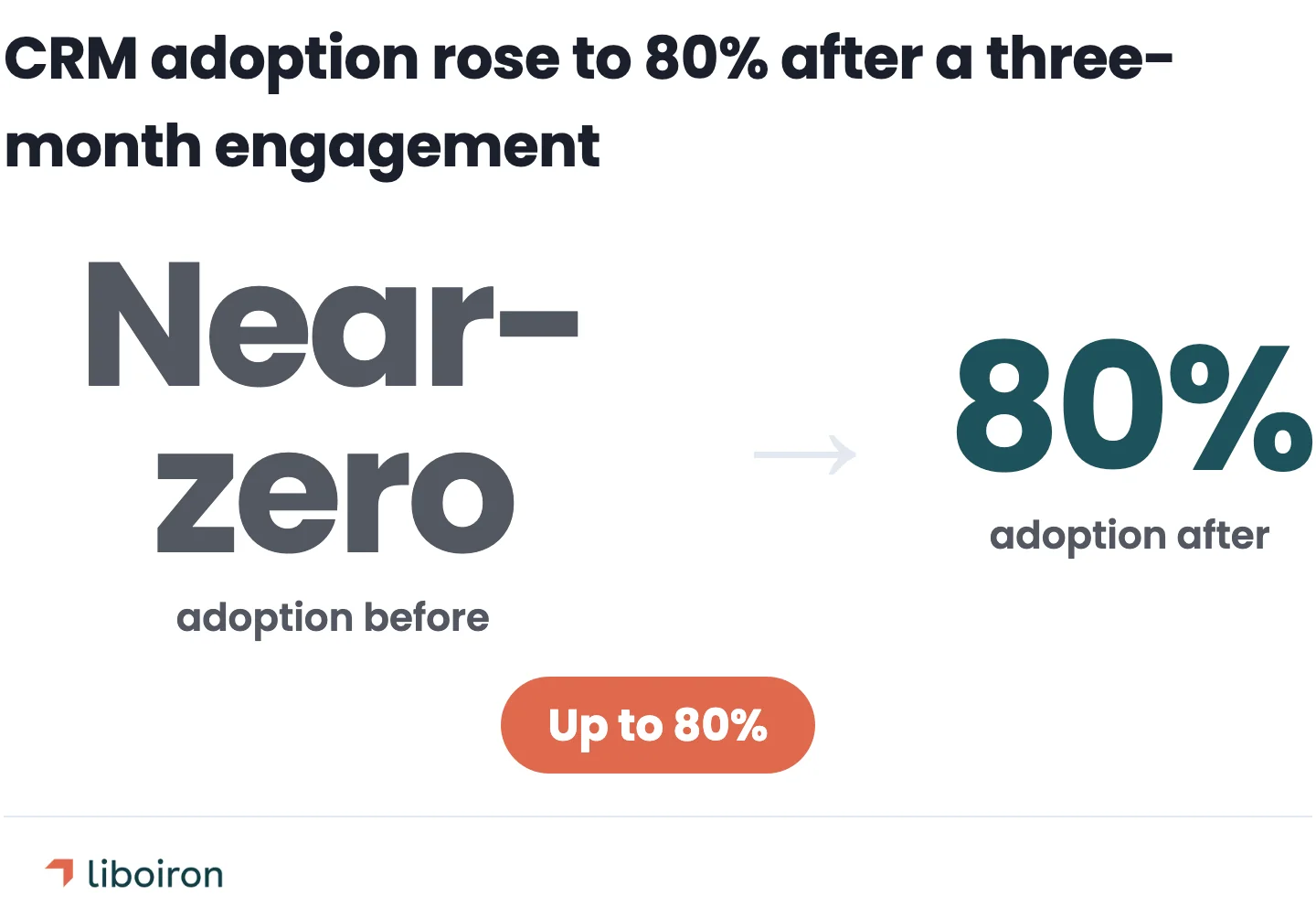
Liboiron worked with Lovepac using a results-guaranteed model, tying compensation to delivering the outcomes defined in the project scope. That structure removed the "are we paying for hours or results?" question that makes many consulting engagements feel risky.
What Does a CRM Consulting Engagement Look Like?
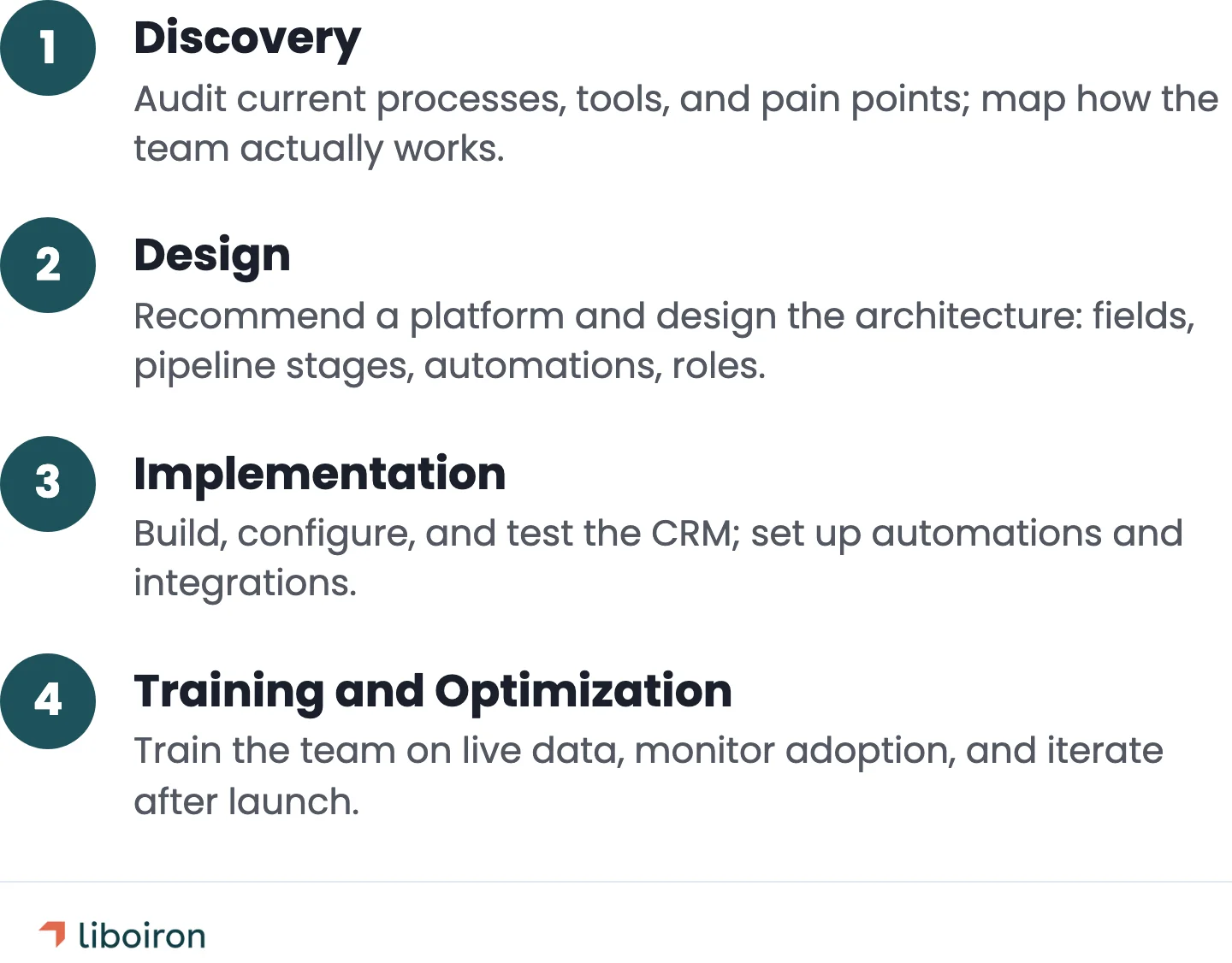
A standard CRM consulting engagement follows four phases: discovery, design, implementation, and optimization. The timeline ranges from 8 to 12 weeks for a standard project and 3 to 6 months for complex multi-department rollouts.
Here is what each phase involves:
Phase 1: Discovery
The consultant audits your current processes, tools, and pain points. This is not a software demo. It is a deep look at how your team actually works: where leads come from, how they move through the pipeline, where deals stall, and what data you need to make decisions.
Good consultants start by asking about your existing workflows and goals before recommending any platform. They map your current state first, then design the future state around it.
Deliverables typically include a process map, a gap analysis, and a list of requirements the CRM must meet.
Phase 2: Design
Based on the discovery findings, the consultant recommends a CRM platform and designs the system architecture. This covers custom fields, pipeline stages, automation rules, user roles, and integrations with your existing tools.
If you are moving from an old system, CRM data migration happens during this phase. Data gets cleaned, mapped to new fields, and validated before import.
Phase 3: Implementation
The CRM gets built, configured, and tested. Automations are set up. Integrations are connected. Sample data runs through the system to catch issues before the full team sees it.
This is where most of the technical work happens: custom fields, pipeline stages, automation rules, user permissions, and dashboard builds. A phased rollout (one team at a time, one use case at a time) reduces risk and lets you learn before scaling.
Phase 4: Training and Optimization
The team gets trained on the live system with their real data. Dashboards are configured for each role. The consultant monitors adoption, adjusts workflows based on how the team actually uses the system, and makes iterations in the weeks after launch.
Our Discover, Design, Deploy, and Evolve methodology follows this same structure. The Evolve phase is what separates a one-time setup from ongoing improvement. Most CRM problems show up in the first 90 days of use, not during configuration.
CRM Consulting Costs in Canada (2026)
CRM consulting costs range from CA$7,000 for a basic setup to CA$135,000 or more for complex multi-department implementations. The biggest cost factors are company size, number of integrations, and how much customization the CRM needs.
Here is what to expect at each tier:
Prices shown in approximate CA$. Most consultants invoice in USD or CAD depending on location.
Ongoing support typically costs 10-20% of the original implementation cost per year. This covers system updates, new automation requests, and troubleshooting.
Is It Worth It?
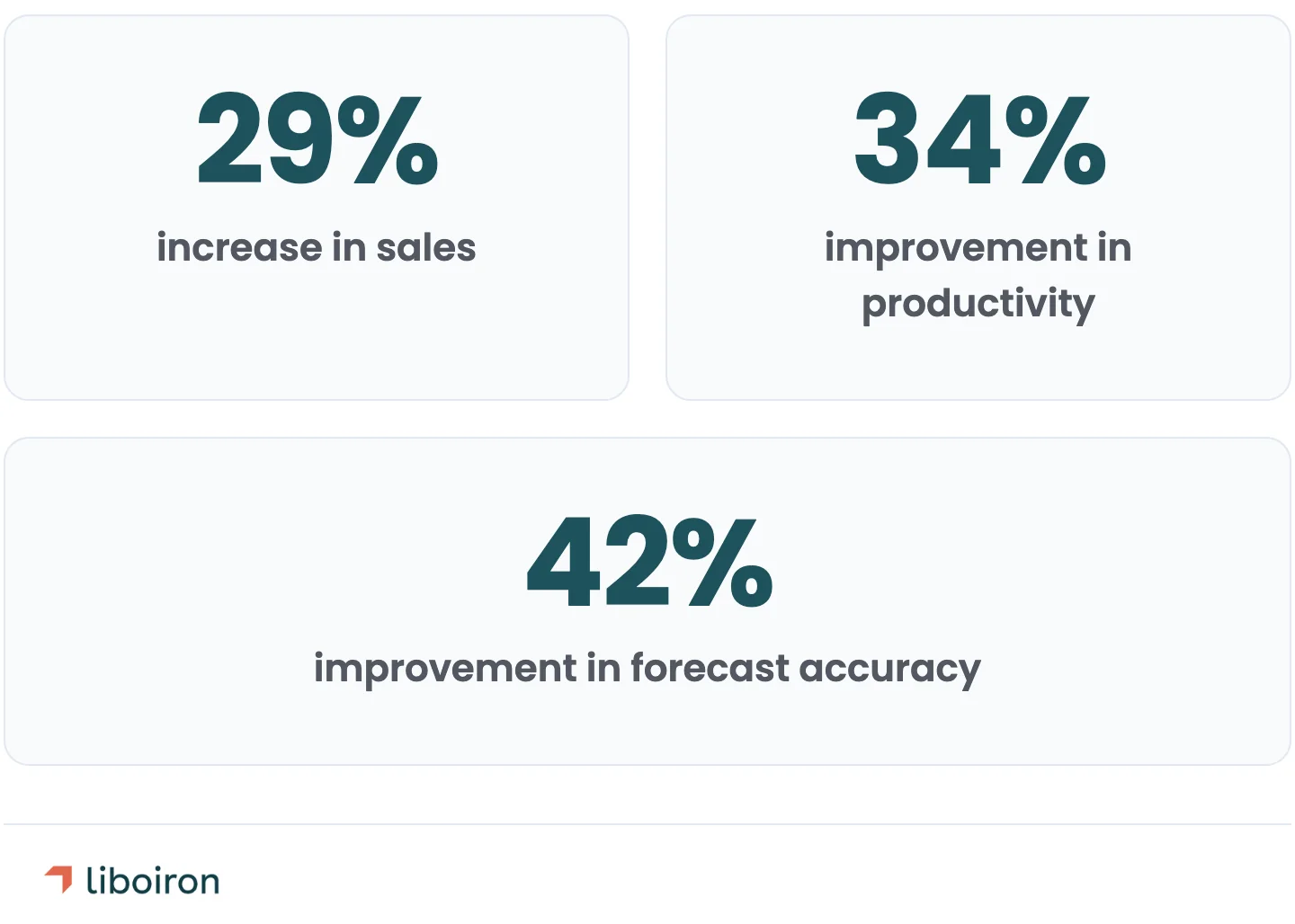
CRM consulting pays for itself through productivity gains. Businesses using CRM report a 29% increase in sales, 34% improvement in productivity, and 42% improvement in forecast accuracy.
Nucleus Research found that CRM returns $8.71 for every dollar spent. That figure is from their original study and has become an industry benchmark. A more recent estimate puts the return at $3.10 per dollar, which reflects a more mature market where the biggest ROI gains have already been captured by early adopters.
Either way, the return is positive. The question is whether you capture that return through a proper implementation or leave it on the table with a half-configured system.
Use our ROI calculator to estimate how much time and money your team could save.
How to Choose the Right CRM Consultant
Not all CRM consultants deliver the same quality of work. Here are six criteria that separate strong consultants from ones who will waste your budget.
1. Platform certifications and partnerships. A certified Pipedrive, HubSpot, or Salesforce partner has been vetted by the platform vendor. They have access to partner resources, priority support, and implementation best CRM practices that uncertified consultants do not.
2. Industry experience in your vertical. A consultant who has implemented CRM for manufacturers understands production scheduling, quoting workflows, and distributor management. One who has only done SaaS implementations will apply a different playbook. Ask for case studies in your industry.
3. A clear methodology they can walk you through. If a consultant cannot explain their process before you sign, they are figuring it out on your dime. Look for a documented approach with defined phases, deliverables, and timelines.
4. Vendor transparency. Some consultants recommend the platform that pays the highest commission. Ask directly: are they a certified partner of one platform (transparent partnership) or do they claim to be "vendor-neutral" while steering you toward specific tools? A declared partnership is more honest than hidden incentives.
5. Post-implementation support. The CRM does not stop needing attention after launch. Ask what happens in month 2, month 6, and month 12. Consultants who disappear after go-live leave you with a system nobody maintains.
6. Verifiable client references. Published case studies with specific metrics (adoption rate, time saved, revenue impact) are stronger than vague testimonials. Ask to speak with a past client in a similar industry. If a consultant cannot show you real numbers from a real project, that tells you something.
For a comparison of CRM consulting firms serving Canadian businesses, see our guide to the top CRM consulting firms in Canada.
CRM Platforms Your Consultant Should Know
The right CRM platform depends on your team size, sales process, and budget. Your consultant should have hands-on experience with at least one of these major platforms:
Salesforce is the enterprise standard. Powerful and highly customizable, but complex and expensive. Best for companies with 100+ users, dedicated admins, and large budgets. Most Salesforce implementations require certified consultants.
HubSpot dominates the mid-market, especially for companies with strong marketing operations. It has a free tier that scales into paid plans. The all-in-one marketing, sales, and service hub makes it popular, but its CRM can feel limiting for complex sales workflows. See our HubSpot implementation guide for more on what that process involves.
Microsoft Dynamics 365 is the choice for companies already deep in the Microsoft ecosystem. It integrates tightly with Outlook, Teams, and Power BI. Best for organizations that need ERP and CRM under one roof.
Pipedrive is built for small and mid-size sales teams that want a CRM focused on pipeline management without enterprise complexity. It is visual, fast to implement, and designed around the daily workflow of salespeople rather than administrators. Liboiron is a Pipedrive Service Partner with direct implementation experience across manufacturing, construction, and property management. See our Pipedrive implementation guide for the full process.
The platform matters less than the implementation. A properly implemented Pipedrive will outperform a poorly implemented Salesforce every time. Your consultant's ability to map your processes to the tool is more important than the tool itself.
Frequently Asked Questions About CRM Consulting
What does a CRM consultant do?
A CRM consultant helps businesses select, set up, and optimize customer relationship management software. The work includes auditing existing sales and service processes, recommending the right CRM platform, configuring the system to match real workflows, migrating data from old tools, connecting the CRM to other business software, and training the team. The goal is a CRM your team actually uses, not one that collects dust.
How much does CRM consulting cost?
CRM consulting costs range from CA$7,000 for basic setup packages to CA$135,000 or more for complex multi-department implementations. A standard engagement covering strategy, platform selection, implementation, and training typically falls between CA$20,000 and CA$34,000. Hourly rates range from CA$100 for junior specialists to CA$475 or more for senior system architects.
What are the main types of CRM systems?
There are four main types of CRM systems. Operational CRMs automate sales, marketing, and service tasks like lead routing, email sequences, and ticket management. Analytical CRMs focus on reporting, forecasting, and customer data analysis to help leadership make decisions. Collaborative CRMs help teams share customer information across departments so sales, marketing, and support see the same data. Strategic CRMs put long-term customer relationships at the centre of business planning. Most modern platforms like Salesforce, HubSpot, and Pipedrive combine elements of all four.
How long does a CRM consulting engagement take?
A standard CRM consulting engagement takes 8 to 12 weeks from discovery through training. This covers process auditing, platform configuration, data migration, integration setup, and team onboarding. Complex projects involving multiple departments, custom automations, or large data migrations can take 3 to 6 months.
The Bottom Line
CRM consulting turns a software purchase into a system your team uses every day. The difference between a CRM that drives revenue and one that gets abandoned comes down to three things: how well it matches your actual sales process, how cleanly your data moves into it, and whether your people are trained to use it.
The investment pays for itself. Businesses that implement CRM with expert guidance see higher sales, better forecasting, and measurable productivity gains. The ones that skip consulting end up paying twice: once for the software, and again to fix the implementation after adoption stalls.
Liboiron is a Pipedrive Service Partner with 18+ years of automation experience, helping Canadian SMBs in manufacturing, construction, and property management get their CRM right the first time.
If your CRM adoption is below where it should be, or you are choosing a platform and want to avoid the mistakes that cause more than half of implementations to fail, book a free strategic call to talk through your options.
Sources
- Johnny Grow: The CRM Failure Rate Is 55 Percent
- DemandSage: CRM Statistics
- SLT Creative: CRM Statistics
- Nutshell CRM: How Much Does CRM Cost
- Nucleus Research: CRM Pays Back $8.71 for Every Dollar Spent
- Nucleus Research: CRM Returns $3.10 Per Dollar Spent
- Sustainable Business Magazine: Why Most CRM Implementations Still Struggle