Table of Contents
You probably already know you need a CRM. The question is whether you need professional help setting it up, fixing what's broken, or getting your team to actually use it.
The short answer: if your implementation involves data migration, multiple integrations, or a team that has resisted CRM before, a consultant will save you time and money. If you have a small team with simple needs and someone willing to learn the platform, you can likely handle it yourself.
Here's why that distinction matters. More than half of CRM implementations fail to meet their stated objectives. The failure almost never comes from the software. It comes from how the system was configured, how data was migrated, and whether the team was trained to use it properly.
If you're still deciding whether you need a CRM at all, we wrote a separate guide on that question. This article assumes you've already decided. The decision now is whether to bring in outside expertise or go it alone.
Liboiron is a Montreal-based CRM implementation agency and Pipedrive Service Partner. We've spent 18+ years helping Canadian SMBs in manufacturing, construction, and property management get their CRM systems working properly. What follows is the same decision framework we walk clients through before a single dollar changes hands.
Key Takeaways
- More than half of CRM implementations fail to meet their objectives, and the primary cause is poor setup and low user adoption, not bad software.
- You need a CRM consultant if you're migrating data from another system, connecting your CRM to multiple tools, or your team has already rejected a CRM rollout once before.
- You can skip the consultant if you have fewer than five users, a simple sales process, and someone on the team willing to own the rollout.
- Expect to invest CA$7,000 to CA$55,000 (~US$5,000 to ~US$40,000) for a project-based engagement, or CA$70 to CA$400+ per hour (~US$50 to ~US$300+) for hourly consulting.
- The real cost isn't the consultant. It's the cost of a failed implementation you have to redo.
7 Signs You Need a CRM Consultant
Not every CRM project needs outside help. But these situations almost always go better with a consultant involved.
1. You're migrating data from another system.
Data migration is where most DIY implementations break down. Field mapping, deduplication, normalizing inconsistent records, preserving relationships between contacts, deals, and activities. Roughly 67% of companies face data migration complications during CRM implementation. A bad migration means duplicate records, lost history, and a team that doesn't trust the new system from day one.
2. Your team has tried CRM before and abandoned it.
Low adoption is the single biggest reason CRM implementations fail. If your sales team tried a CRM and went back to spreadsheets, the problem wasn't the software. It was the setup. A consultant rebuilds the CRM around your team's actual workflow instead of forcing people into a default configuration nobody asked for.
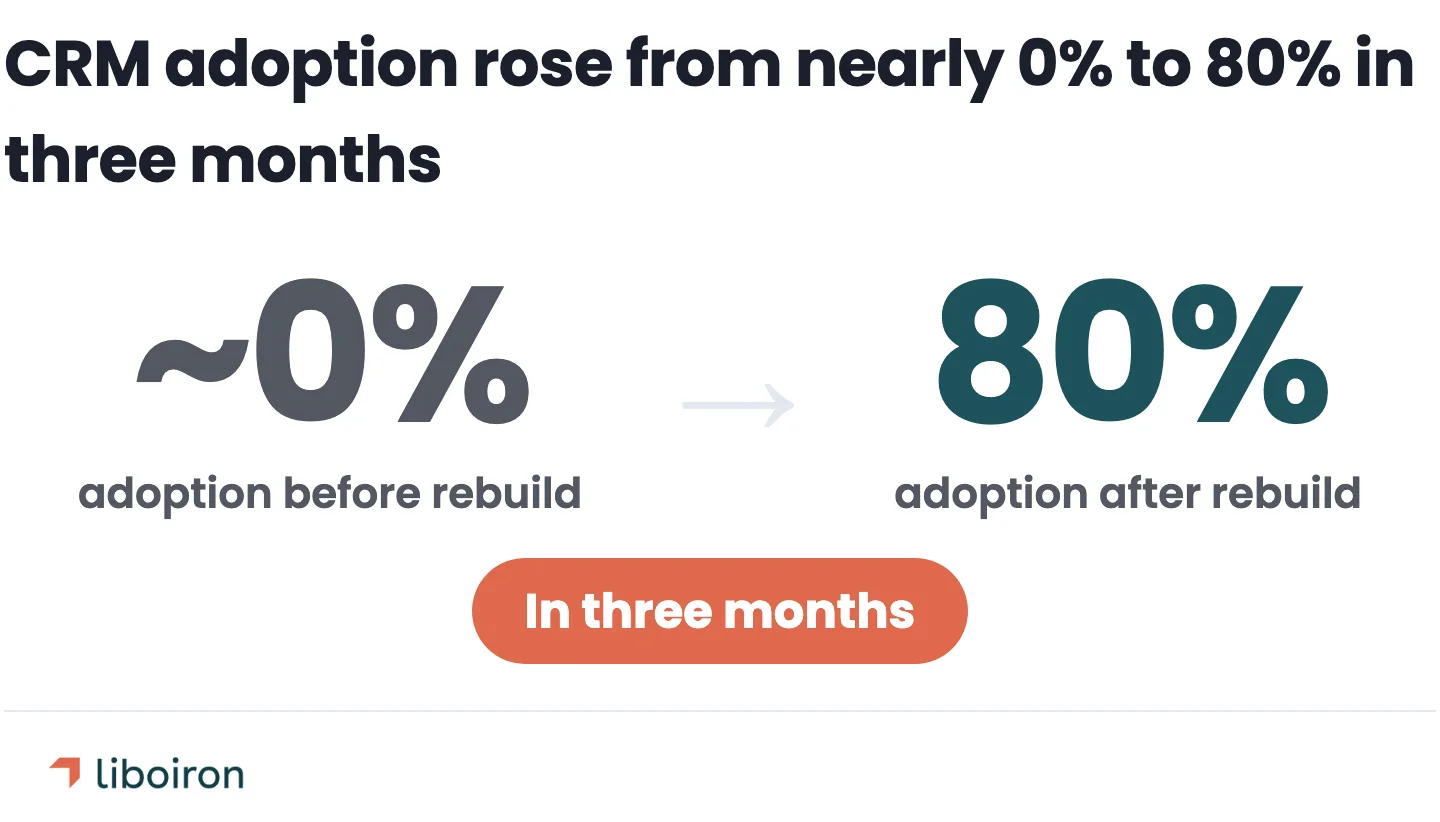
One example: a packaging manufacturer we worked with had HubSpot installed but was using less than 10% of its features. Their VP of Sales had zero visibility into the pipeline. After rebuilding the system around how the team actually sold, adoption went from nearly 0% to 80% in three months.
3. You need to connect your CRM to other tools.
CRM becomes powerful when it talks to your other systems: QuickBooks for invoicing, your marketing platform for lead scoring, your ERP for order management. Each integration adds complexity. When data flows between four or five tools, one misconfigured connection can break the whole chain. A consultant maps the integrations before building them.
4. Nobody on the team has time to own the rollout.
CRM implementation takes weeks of focused work. Configuration, data cleanup, testing, training, troubleshooting. If nobody on your team can carve out 10 to 15 hours per week for two to three months, the project will stall. 42% of businesses cite lack of CRM training or expertise as their biggest barrier to successful implementation. Buying a licence and hoping your team figures it out is not a strategy.
5. You need reporting and dashboards, not just a contact list.
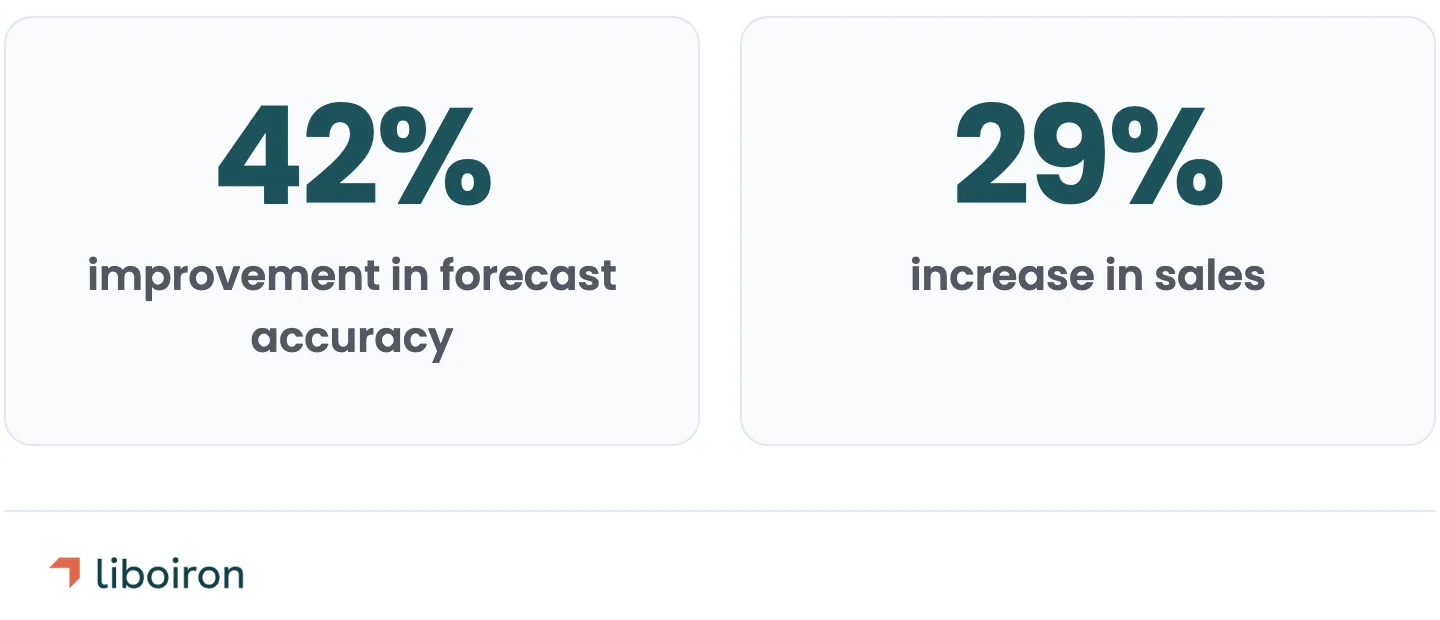
If you bought a CRM to get pipeline visibility, forecast accuracy, and performance tracking, that doesn't happen with default settings. Someone has to build the reports, define the pipeline stages, set up deal properties, and train the team on what the numbers mean. Companies using CRM effectively see a 42% improvement in forecast accuracy and a 29% increase in sales. But "effectively" means configured properly.
6. You've already had a failed implementation.
Nearly a quarter of companies invest in improving their CRM after the initial setup didn't deliver. If your first attempt produced a system nobody uses or a database full of bad data, bringing in a consultant to diagnose what went wrong is faster and cheaper than trying the same approach again.
7. You're scaling fast and your processes are breaking.
Manual data entry, disconnected tools, and ad-hoc workflows that worked at 10 employees start to collapse at 50. Growth creates operational bottlenecks. A consultant helps you build systems that scale with you rather than patching what's already cracking.
When You Don't Need a CRM Consultant
Hiring a consultant isn't always the right call. You can probably handle CRM setup on your own if:
- You have fewer than five users with a straightforward sales process.
- You're starting fresh on a new CRM with no data migration required.
- You're using a modern, user-friendly platform (Pipedrive, HubSpot Starter) with built-in onboarding guides.
- Someone on your team is willing to be the "CRM Champion": the internal owner who learns the system, configures it, and drives adoption across the team.
- You need simple CRM integrations or none at all.
Most CRM platforms offer free training resources. HubSpot Academy, Salesforce Trailhead, and Pipedrive Academy all have courses that walk you through setup, configuration, and basic automation. For a small team with simple needs, these resources are a legitimate alternative to hiring outside help.
The honest test: if the implementation involves more than one of the seven signs listed above, DIY gets risky. One factor is manageable. Two or three together is where projects go sideways.
What Does a CRM Consultant Cost?
CRM consulting rates in Canada vary by experience, platform, and project scope. Based on current market data:
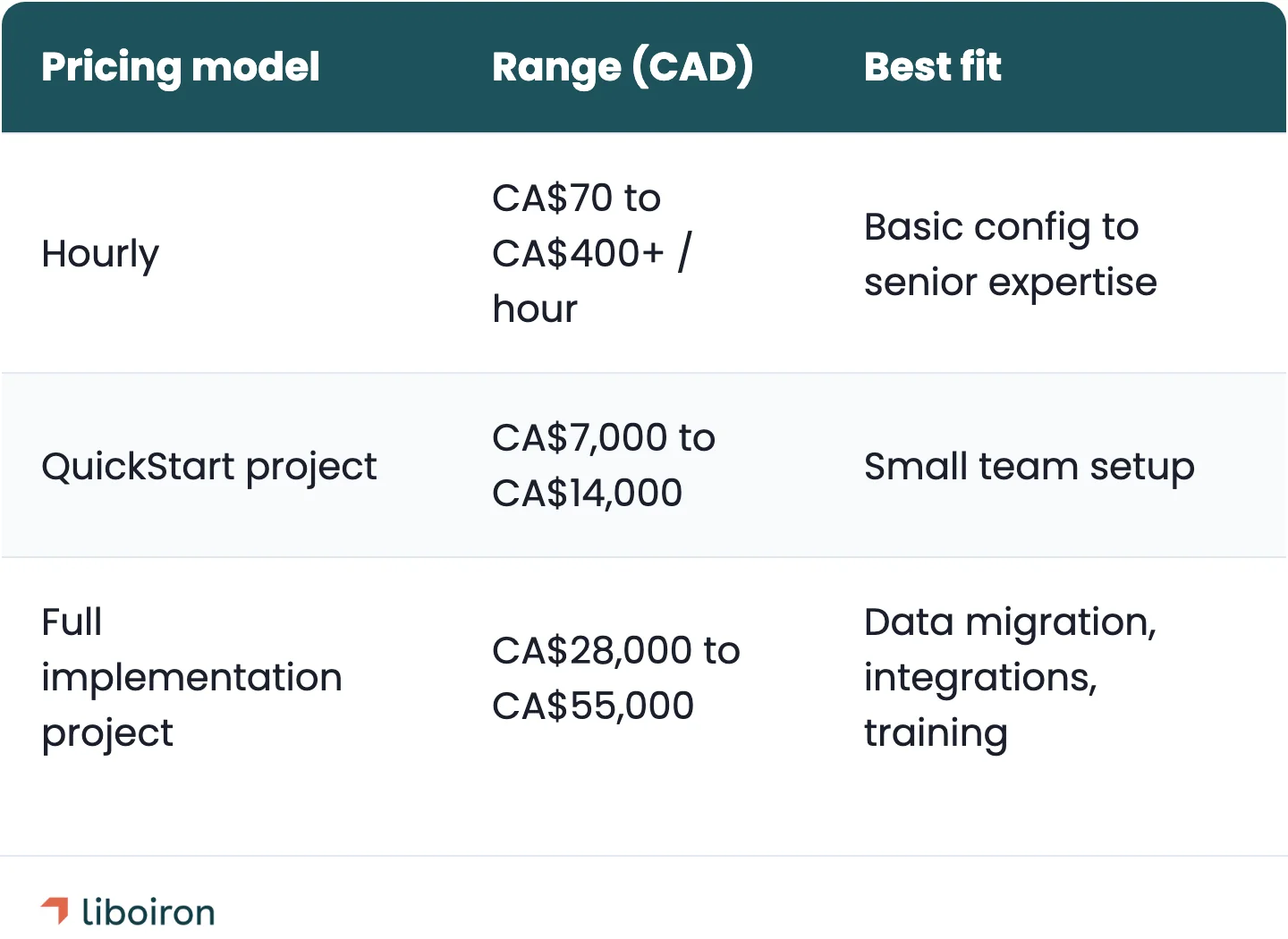
Hourly rates range from CA$70 to CA$400+ (~US$50 to ~US$300+) per hour. Junior consultants handling basic configuration start around CA$40 to CA$110 (~US$30 to ~US$80). Mid-level consultants with platform certifications run CA$110 to CA$200 (~US$80 to ~US$150). Senior consultants with deep industry expertise charge CA$200 to CA$350+ (~US$150 to ~US$250+).
Project-based pricing is more common for full implementations. A QuickStart setup for a small team typically costs CA$7,000 to CA$14,000 (~US$5,000 to ~US$10,000). A mid-sized company with data migration, integrations, and training can expect CA$28,000 to CA$55,000 (~US$20,000 to ~US$40,000).
Some consulting firms tie compensation to the results they deliver rather than billing by the hour or by the project. This shifts the financial risk from you to the consultant. If you're worried about paying for hours that don't produce outcomes, ask about results-based pricing models.
The comparison that matters: spending CA$20,000 on a proper implementation upfront versus spending CA$40,000+ to fix a failed one later. The average return on CRM investment is $8.71 for every $1 spent, according to Nucleus Research. That return only materializes when the system is set up correctly and your team actually uses it.
You can estimate your potential return before committing. Our ROI calculator helps you model the time and cost savings based on your current operations.
How to Choose the Right CRM Consultant
If you've decided you need outside help, here's what to look for:
Platform expertise. A consultant who is a certified partner of your CRM platform (Pipedrive, HubSpot, Salesforce) has access to training, support channels, and implementation best practices that generalists don't. Ask about verified partnerships, not just "experience with."
Industry experience. Manufacturing, construction, professional services, and property management each have distinct CRM needs. A consultant who has worked in your industry understands your sales cycle, your data structure, and the workflows your team relies on. Generic CRM advice misses the nuances.
Documented results. Ask for case studies with specific metrics. "We improved CRM adoption" means nothing. "CRM adoption went from 0% to 80% in three months" or "lead processing dropped from 15 minutes to 5 minutes per inquiry" means something.
A clear methodology. Look for a phased approach: discovery, design, deployment, iteration. A consultant who starts configuring on day one without understanding your processes first is a red flag. A structured methodology prevents scope creep and ensures the system is built around your actual needs.
Post-launch support. CRM implementation doesn't end at go-live. The first 30 to 90 days after launch determine whether adoption sticks. Ask about training plans, adoption monitoring, and optimization support after deployment.
Frequently Asked Questions
How much does a CRM consultant cost in Canada?
Expect CA$7,000 to CA$55,000 (~US$5,000 to ~US$40,000) for a project-based engagement, or CA$70 to CA$400+ per hour (~US$50 to ~US$300+) for hourly consulting. Rate depends on the consultant's seniority, the platform, and whether the project involves data migration and integrations.
What does a CRM consultant do?
A CRM consultant maps your sales process, configures the CRM around it, migrates and cleans your data, connects it to your other tools, and trains your team to use it. The work sits in the gap between buying a licence and having a system your team actually uses.
Can I set up a CRM without a consultant?
Yes, if you have fewer than five users, a straightforward sales process, no data to migrate, and someone willing to own the rollout as an internal "CRM Champion." Free resources like HubSpot Academy, Salesforce Trailhead, and Pipedrive Academy cover setup for simple needs.
How long does a CRM implementation take?
Plan for focused work over two to three months, with someone carving out 10 to 15 hours per week for configuration, data cleanup, testing, and training. Projects stall most often when nobody has the time to own that work.
Is a CRM consultant worth the cost?
The return comes from getting the setup right the first time. The average return on CRM investment is $8.71 for every $1 spent, but that only materializes when the system is configured properly and adopted — and the real risk is paying CA$40,000+ to fix a failed implementation you could have done right for half that.
The Bottom Line
You need a CRM consultant if the implementation involves data migration, multiple integrations, team adoption challenges, or reporting requirements beyond the basics. You don't need one if you have a small team, simple needs, and someone willing to own the setup.
The deciding factor is risk. The more complex the project, the more expensive it is to get wrong.
Liboiron helps Canadian SMBs turn underperforming CRMs into tools their teams actually use, backed by a results-guaranteed delivery model and 18+ years of automation expertise.
If you're unsure whether your CRM project needs outside help, book a free strategic call to talk through your situation. No commitment, no pitch. Just an honest assessment of whether a consultant would make a difference for your business.