Table of Contents
An AI automation consultant builds systems that handle the work rule-based software can't: decisions that need judgment, documents that don't follow a template, and multi-step tasks that change as conditions change. They find where AI agents fit in your operations, build and deploy them, connect them to your existing tools, and train your team to run them.
That distinction matters. Traditional automation follows fixed rules. AI automation reasons through ambiguity. Knowing which of your processes need which is the consultant's first job, and it decides everything that follows.
Canadian SMBs are catching on. Only 30% of Canadian SMEs used AI in 2025, but those that did were 24% more productive than those that didn't. If you're considering hiring an AI automation consultant, here's what you need to know first.
Key Takeaways
- AI automation consultants build AI agents and intelligent workflows, not just rule-based automations. The distinction matters for ROI and long-term scalability.
- 88% of organizations now use AI automation in at least one business function, up from 55% in 2023.
- AI agent implementations reach production in 4-6 weeks, compared to 6-9 months for traditional RPA projects.
- Results-guaranteed pricing models exist. Some consultants tie their compensation to delivering agreed-upon outcomes, not billing hours.
- Canada's BDC LIFT program offers CA$25K to CA$5M in loans with preferential rates for businesses choosing Canadian AI solutions.
What Does an AI Automation Consultant Do?
An AI automation consultant identifies where intelligent automation can save your business time and money, then builds and deploys the systems to make it happen. They sit at the intersection of business strategy and AI engineering, focusing on operational problems that rule-based software can't solve.
According to BDC research, only 30% of Canadian SMEs used AI in 2025, but those businesses were 24% more productive. The gap between AI adopters and holdouts is widening, and 88% of organizations now use AI automation in at least one business function.
The scope typically covers four areas:
Workflow audits and AI-fit triage. They map your current processes, find the bottlenecks eating the most time, and rank opportunities by ROI. The part that separates an AI consultant from a traditional one: they tell you which processes actually need AI and which a simple rule would solve for a fraction of the cost. A manufacturing company spending 15 hours a week on manual data entry is a rules problem. A firm drowning in unstructured tenant inquiry emails is an AI problem. The audit sorts them.
System integration. They connect AI tools to the software you already use. CRM, ERP, accounting, HR, communication platforms. The goal isn't replacing your tech stack. It's making the pieces talk to each other intelligently so data flows without manual re-entry.
Custom tool deployment. This is where AI automation diverges from traditional consulting. Instead of configuring off-the-shelf software, AI consultants build purpose-built tools: agents that process invoices, chatbots that handle customer inquiries, or data enrichment systems that qualify leads automatically.
A traditional consultant might integrate your CRM with your accounting software. An AI automation consultant builds an agent that reads incoming purchase orders, cross-references inventory, drafts responses, and flags discrepancies for human review.
Team training and agent oversight. An AI system isn't set-and-forget. Your team has to know how to prompt it, when to trust its output, and how to spot when it starts drifting on edge cases it wasn't built for. Consultants who build workflows, train for an hour, and leave often see half the team revert to manual processes. Training and ongoing oversight are part of the job, not an afterthought.
Three Types of Automation (and Which Ones Need AI)
There are three tiers of automation: deterministic (rule-based), AI-powered (LLMs and machine learning), and agentic (autonomous, multi-step AI agents). An AI automation consultant works across all three but specializes in the second and third. Understanding which tier your problem falls into helps you avoid paying for AI where a simple rule would do.
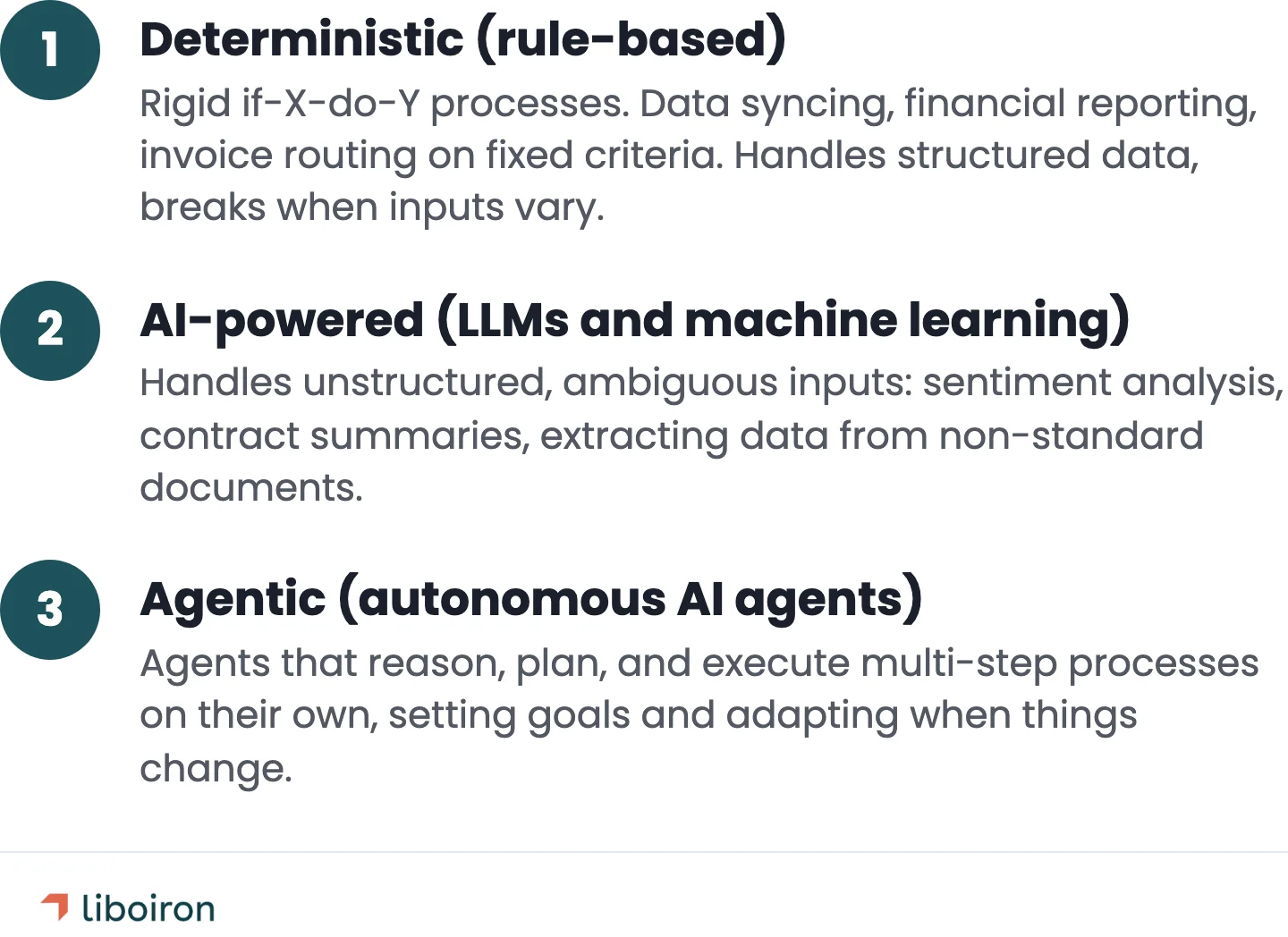
Deterministic automations are rigid, rule-based processes. If X happens, do Y. Data syncing between systems, financial reporting, invoice routing based on fixed criteria. They handle structured data well but break when inputs vary. Traditional RPA falls here.
AI-powered automations use large language models (LLMs) and machine learning to handle unstructured, ambiguous inputs: sentiment analysis on customer feedback, summarizing long contracts, extracting key data points from documents that don't follow a standard format. Where rule-based systems say "I don't recognize this input," AI-powered systems figure it out. According to an Artificio study, AI agents outperform traditional RPA by 40% when processing unstructured documents, with 97% classification accuracy.
Agentic automations are the newest tier. These are AI agents that reason, plan, and execute multi-step processes autonomously without following fixed instructions. They set goals, decide how to achieve them, and adapt when things change. The AI agent market is projected to reach CA$72 billion (~US$52.62 billion) by 2030, growing at 46.3% annually.
If your processes only need deterministic rules, a simpler integration tool might be enough. If you're dealing with unstructured data, judgment calls, or multi-step workflows, that's where an AI automation consultant earns their fee.
What to Expect from an AI Automation Engagement
Most AI automation engagements follow a four-phase pattern: assess, design, deploy, optimize. Two steps make an AI engagement different from a traditional automation project: a tier-decision in the design phase (which processes get rules, which get AI) and a data-readiness check that often dictates the whole timeline.
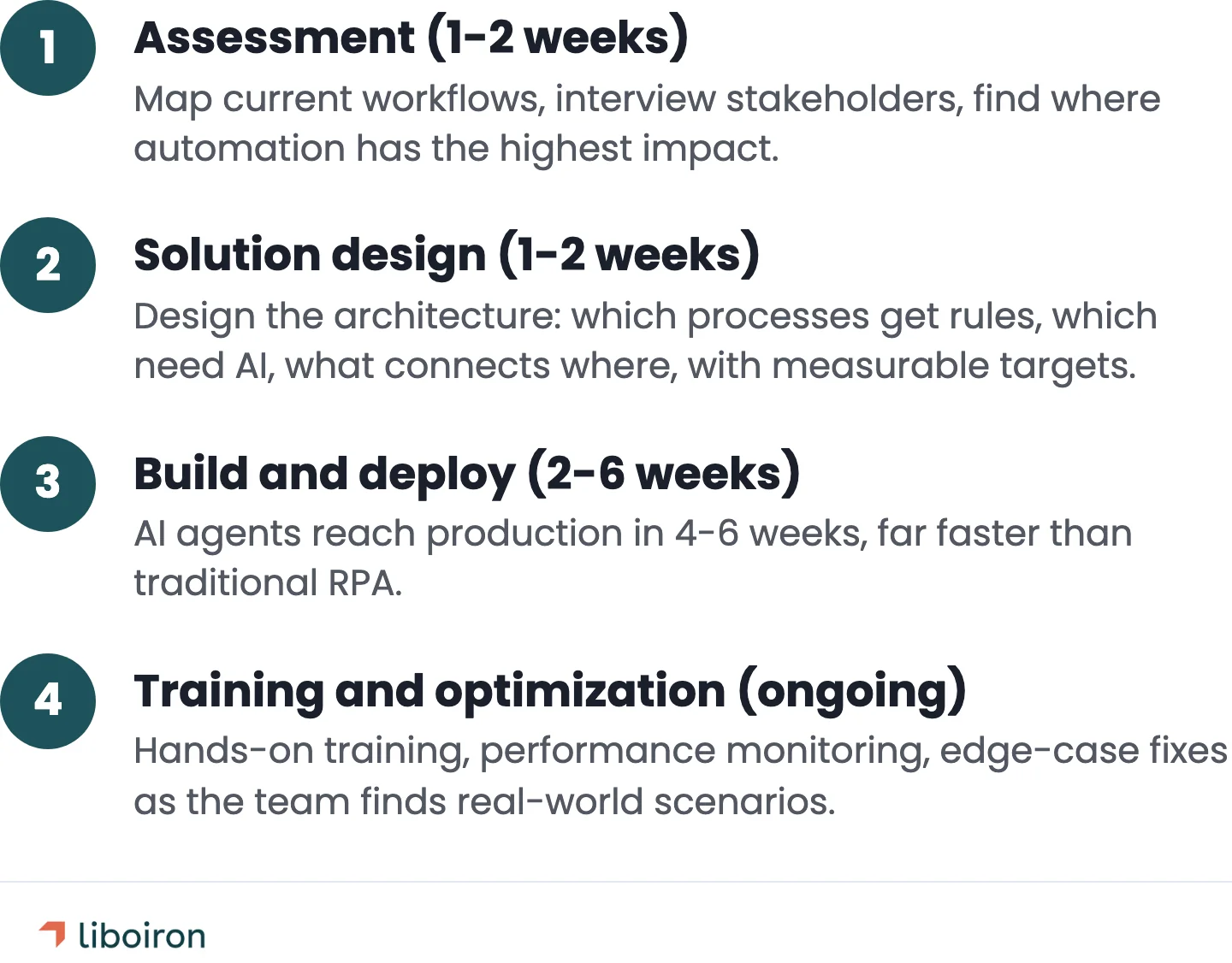
Phase 1: Assessment (1-2 weeks). The consultant maps your current workflows, interviews stakeholders, and identifies where automation will have the highest impact. This isn't a generic questionnaire. A good consultant observes how your team actually works, not just how they describe their process. Planning the project properly at this stage prevents scope creep later.
Phase 2: Solution design (1-2 weeks). Based on the assessment, the consultant designs the automation architecture. Which processes get deterministic rules, which ones need AI, what tools connect where, and what the team needs to learn. You should see a clear map of before vs. after with measurable targets.
Phase 3: Build and deploy (2-6 weeks). AI agent implementations typically reach production in 4-6 weeks, significantly faster than traditional RPA projects, which average 6-9 months. Pre-built agent frameworks accelerate this further. Rather than building from scratch, consultants who maintain reusable agent architectures can deploy faster and iterate on a proven foundation. Liboiron follows a Discover, Design, Deploy, Evolve methodology built for this kind of work.
Phase 4: Training and optimization (ongoing). This phase separates good consultants from bad ones. The system goes live, but the work isn't done. Your team needs hands-on training, not a one-hour walkthrough. The consultant monitors performance, fixes edge cases, and optimizes as your team finds real-world scenarios the initial build didn't anticipate.
The 55% of executives who laid off staff expecting AI to fill the gap and later said they'd decide differently learned this lesson the hard way. AI automation works best when it augments your team, not replaces it. A good consultant makes sure the humans and the agents are working together.
How AI Automation Consultants Deliver ROI
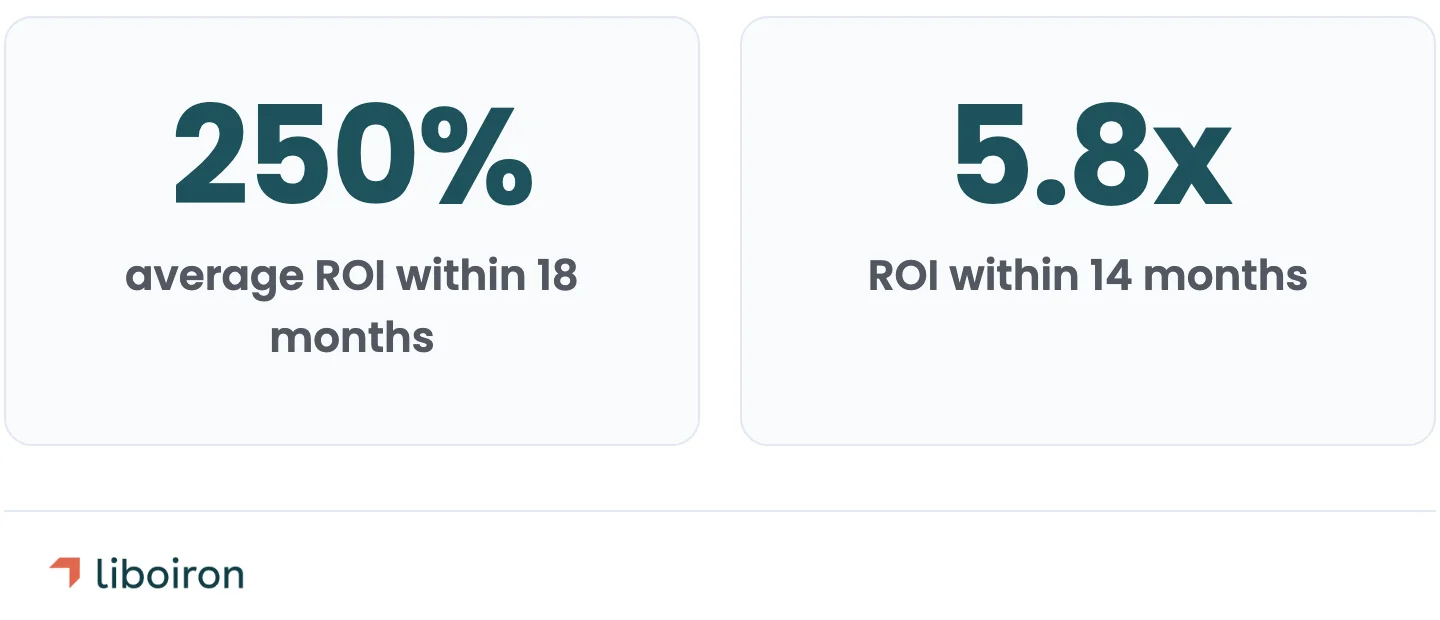
Organizations that invest in AI automation report an average ROI of 250% within 18 months, with companies seeing returns averaging 5.8x ROI within 14 months. AI agent implementations specifically deliver 3.2x the ROI of traditional RPA over three years, with 80% lower configuration and maintenance costs.
But aggregate stats don't tell the whole story. Here's what AI automation looks like in practice:
Emergency mobilization, automated. Groupe EEA, a Quebec construction company with 300 employees, needed to survey 150-200 workers for availability during power line emergencies. The manual process took 2 hours. An automated system using SMS collection, intelligent roster management, and automated customs document generation cut mobilization time by 50%, to 1 hour, with zero roster errors.
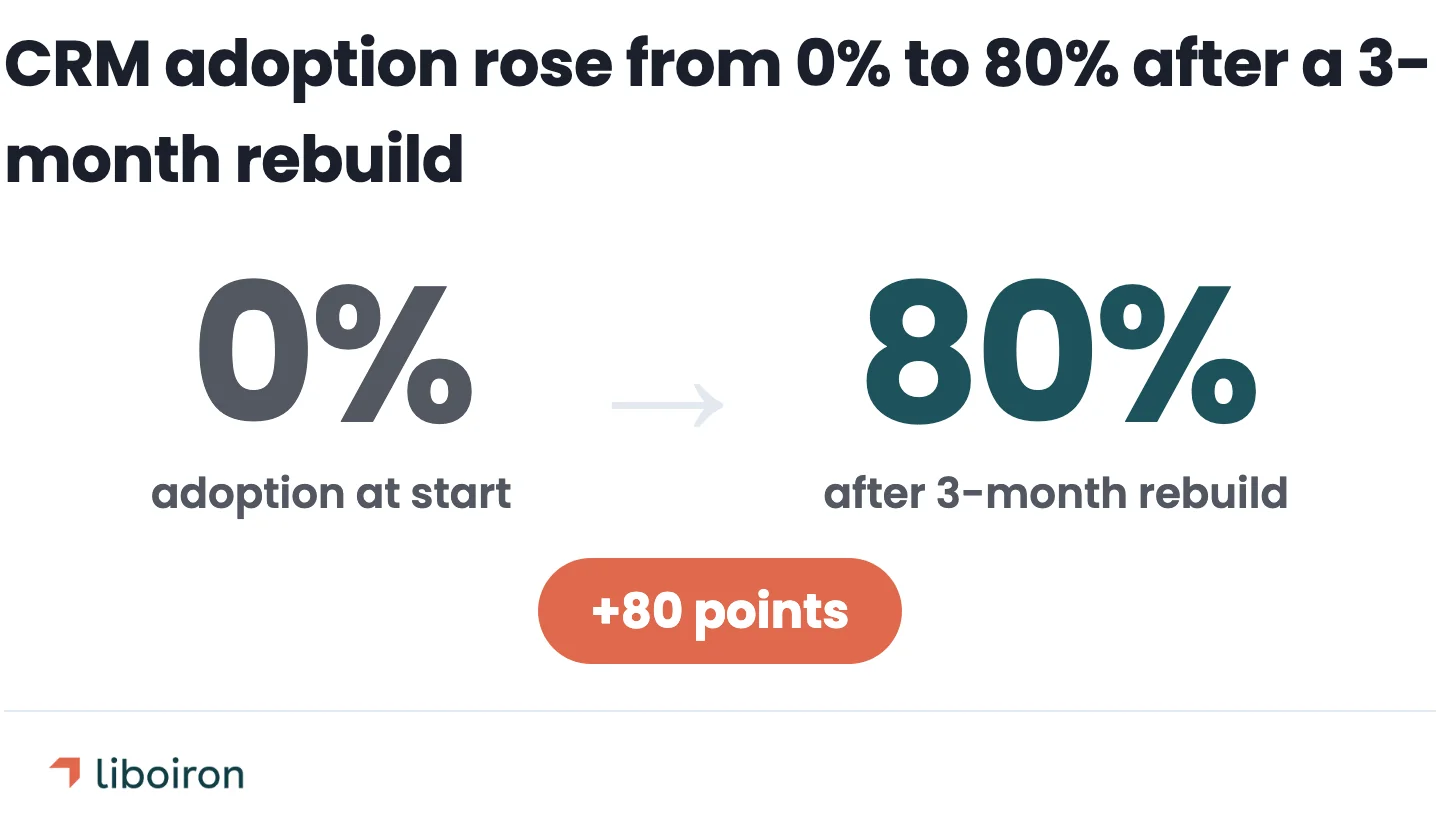
AI-powered data enrichment for manufacturing. Lovepac, a packaging manufacturer, had a HubSpot CRM running at 10% capacity. Their VP of Sales had zero visibility into the pipeline. AI-powered data enrichment for new opportunities, combined with a CRM rebuild, pushed adoption from 0% to 80%, created 15 dashboard reports, and shortened the sales cycle by 20%. Timeline: 3 months.
These results come from connecting AI agents to real operational problems, not from buying software and hoping it works. Pre-built AI agents, like an invoice matching agent that automates three-way matching between purchase orders, invoices, and receiving slips, deliver results faster because the core logic is already proven. The customization is in connecting the agent to your specific systems and workflows.
58% of small businesses using AI report saving 20+ hours per month, and 84% of organizations report positive ROI from AI investments. The challenge isn't whether AI automation works. It's making sure the implementation is tailored to your specific operations, not a generic template dropped onto your business.
How Much Does AI Automation Consulting Cost in Canada?
Most AI automation projects for Canadian SMBs cost between CA$7,000 and CA$42,000, depending on scope. Here's how the market breaks down:
Hourly rates range from CA$140-CA$210 (~US$100-150) for junior consultants to CA$420-CA$700+ (~US$300-500+) for senior specialists.
Hidden costs to budget for: A CA$14,000 project often becomes CA$17,500-CA$19,500 when you factor in software subscriptions, training time, and ongoing maintenance. Ask about total cost of ownership upfront.
Canadian funding option: The BDC's LIFT program provides CA$25,000 to CA$5 million in loans for AI adoption, with a preferential 2.25% interest rate when you choose Canadian AI solutions. This can meaningfully offset project costs.
Some consultants offer results-guaranteed pricing, tying their compensation to delivering agreed-upon outcomes rather than billing hours. This model removes the "is the quoted time accurate?" anxiety and aligns the consultant's incentive with yours. You can use an ROI calculator to estimate potential savings before committing.
How to Evaluate an AI Automation Consultant
The AI automation consulting market is growing fast, and not every consultant delivers. Here's what separates the ones who build real systems from the ones who hand you a slide deck and a bill.
Confirm they'll talk you out of AI where you don't need it. The clearest signal of a real AI consultant is one who recommends a simple rule-based automation when that's all a process needs, instead of selling AI into every workflow. Ask them to point to a recent project where they chose *not* to use AI. If they can't, they're selling a product, not solving your problem.
Check whether they build or just wire up no-code tools. Some "AI consultants" only connect off-the-shelf apps with a no-code connector. That's fine for simple jobs, but it breaks on anything that needs custom logic or a real agent. Ask whether they build and maintain their own agents or resell someone else's.
Look for industry-specific experience. A consultant who's automated processes in manufacturing understands production workflows, quality control bottlenecks, and ERP integration challenges. Someone who's only built marketing chatbots will struggle. Ask which industries they've worked in and for references from companies similar to yours.
Ask for case studies with numbers. Vague claims like "we saved our clients time" mean nothing. Push for specifics: hours saved per week, percentage reduction in errors, time to deployment, adoption rates after 90 days. If a consultant can't show measured results, they haven't measured them.
Check their methodology. Good consultants have a repeatable framework. Ask how they assess your current processes, how they decide which automations to build first, and how they handle training. If the answer is "it depends" without a structured approach behind it, that's a flag.
Verify ongoing support. One of the most common complaints about AI consultants is that they build the system and disappear. Ask what happens after deployment: is there a training period, an optimization phase, and who do you call when something breaks at 2 PM on a Tuesday?
Questions to ask before signing:
- "Can you show me a case study with measured results from a company similar to mine?"
- "What happens after deployment? What does ongoing support look like?"
- "Which of my processes actually need AI, and which can use simpler rule-based automation?"
- "What's the total cost of ownership, including software, training, and maintenance?"
- "How do you handle change management and team adoption?"
Red flags to watch for:
- No proof of results. Testimonials without metrics. Case studies without numbers.
- AI for everything. Some processes need simple rule-based automation, not AI. A consultant who recommends AI for every workflow is either upselling or doesn't understand the automation spectrum.
- No change management plan. If there's no plan for team training and adoption, you're buying software, not a solution.
- Vague pricing. "It depends" is fine as an initial answer. "It depends" as a final answer is not. Get a written scope and price before work begins.
- No local presence or references. For Canadian businesses, working with a consultant who understands the local regulatory environment, provincial business norms, and available government funding (like BDC LIFT) makes a real difference.
Is AI Automation the Same as RPA?
No. Robotic process automation (RPA) handles structured, predictable tasks using fixed rules. It's good at repetitive data entry, form filling, and moving information between systems when the format never changes.
AI automation handles the grey areas. Unstructured documents, variable inputs, decisions that need judgment. AI agents outperform RPA by 40% on unstructured document processing and reach production in weeks, not months. For most businesses, the right approach combines both: rules where rules work, AI where they don't. Learn how data entry automation works.
How Long Does an AI Automation Project Take?
Most AI agent deployments take 4-6 weeks from kickoff to production. Larger projects involving multiple departments, custom integrations, and extensive training can take 3-6 months.
Real timelines from completed projects: an emergency mobilization system for a 300-person construction company took 2-3 months. A CRM rebuild with AI data enrichment for a manufacturing company took 3 months. Both included assessment, build, training, and optimization.
The biggest variable isn't complexity. It's data readiness. Clean, organized data means faster deployment. Scattered data across disconnected spreadsheets adds weeks to the assessment phase alone.
Consultants who maintain pre-built agent frameworks can move faster because the core logic is already tested. Customization focuses on connecting the agent to your specific systems, not writing from scratch.
Also read: How to Implement HubSpot CRM
Frequently Asked Questions
Will AI automation replace my employees?
No — it works best augmenting your team, not replacing it. The 55% of executives who laid off staff expecting AI to fill the gap later said they'd decide differently. A good AI automation consultant makes sure the humans and the agents work together.
How is an AI automation consultant different from a traditional automation consultant?
Traditional automation follows fixed rules; AI automation reasons through ambiguity. A traditional consultant might integrate your CRM with your accounting software, while an AI automation consultant builds an agent that reads incoming purchase orders, cross-references inventory, drafts responses, and flags discrepancies for human review.
What is agentic automation?
Agentic automation uses AI agents that reason, plan, and execute multi-step processes autonomously, adapting when conditions change rather than following fixed instructions. It's the newest of the three automation tiers, and the AI agent market is projected to reach CA$72 billion (~US$52.62 billion) by 2030.
Is there funding for AI automation in Canada?
Yes. The BDC's LIFT program provides CA$25,000 to CA$5 million in loans for AI adoption, with a preferential 2.25% interest rate when you choose Canadian AI solutions, which can meaningfully offset project costs.
Do I need clean data before starting?
Data readiness is the single biggest variable in your timeline. Clean, organized data means faster deployment; data scattered across disconnected spreadsheets can add weeks to the assessment phase alone.
Is an AI Automation Consultant Worth It?
An AI automation consultant builds intelligent systems that handle the work your team shouldn't be doing manually. The market is growing because the results are real: faster processes, fewer errors, and measurable cost savings within months of deployment.
The key is hiring someone with real experience building AI agents for businesses like yours, not a generalist who learned about AI last year. Look for case studies with numbers, a clear methodology, and a commitment to training your team after the build.
Liboiron builds and deploys AI agents for Canadian SMBs in manufacturing, construction, and industrial operations, backed by 18+ years of automation experience and a results-guaranteed pricing model. We maintain pre-built AI agents for invoice matching, order processing, and payroll approval that can be deployed in weeks and customized to your systems.
If you're evaluating AI automation consultants, book a free strategic call to see where automation can have the highest impact on your operations.
Sources
- BDC: Artificial Intelligence for Your Small Business
- Thunderbit: AI Automation Statistics
- Orbilontech: AI Automation Market Analysis
- Artificio: AI Agents vs RPA Performance Study
- Joget: AI Agent Market Forecast
- Xenoss: AI Agent Implementation Timelines
- BetaKit: BDC LIFT Program
- AIEssentials: Hidden Costs of AI Consulting
- Dominik Gabor: AI Consulting Delivery Failures
- TheAIHat: Change Management in Automation
- WhatJobs: AI Workforce Impact
- Adai News: AI Small Business Time Savings