Table of Contents
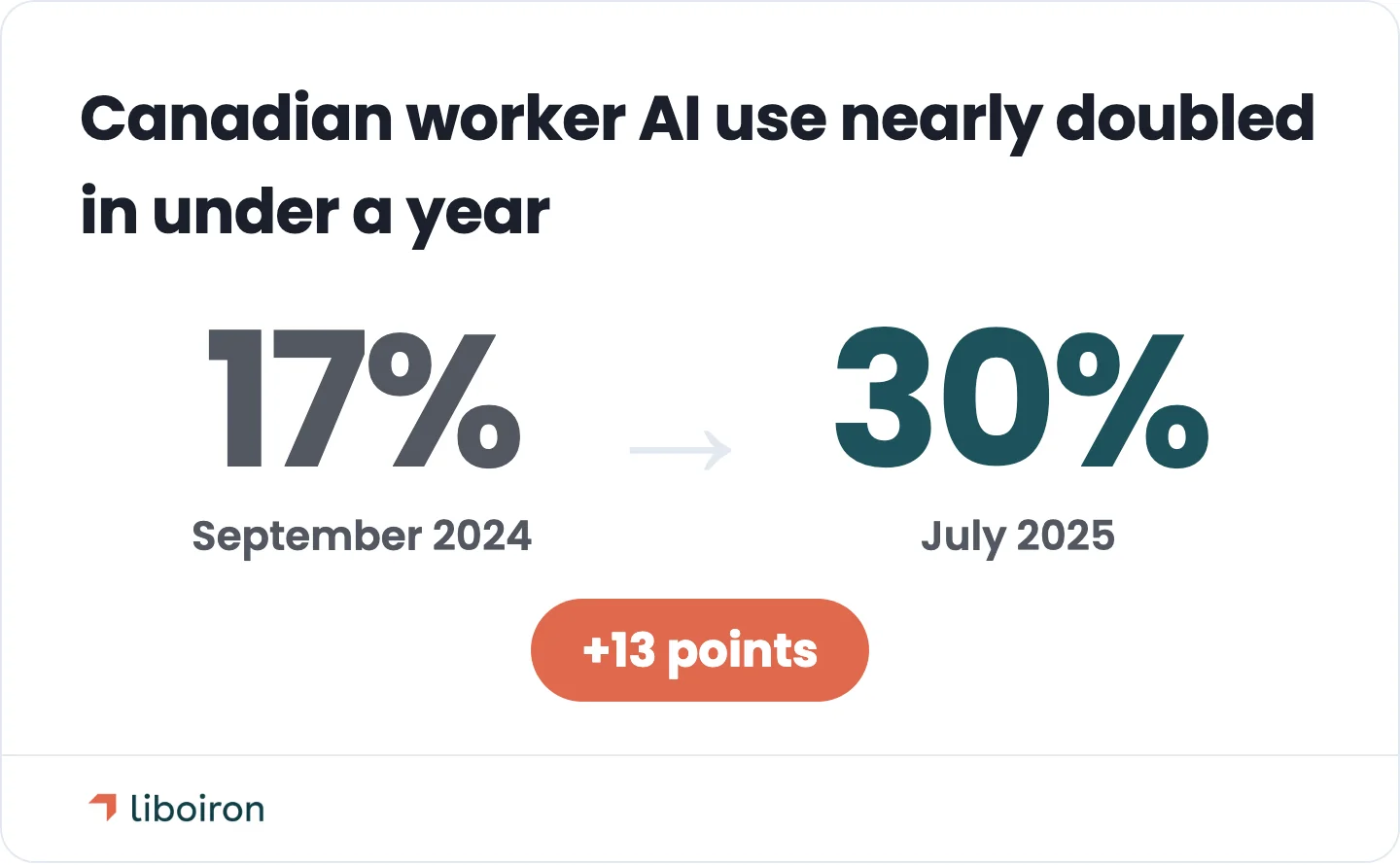
Generative AI use among Canadian workers nearly doubled in under a year, rising from 17% in September 2024 to 30% in July 2025. That one jump tells you where work is headed: adoption is moving faster than the policies, training, or job forecasts meant to keep up with it.
This page pulls together the most current AI in the workplace statistics for Canada and the wider world. Every figure is sourced and linked to its original report, and the Canadian data leads because that is where the clearest, most recent government numbers now sit. Figures are current as of July 2026.
Key Takeaways
- Canadian worker adoption nearly doubled in under a year. Generative AI use rose from 17% in September 2024 to 30% in July 2025, per Statistics Canada.
- Business adoption is low but climbing fast. The share of Canadian businesses using AI doubled from 6.1% to 12.2% in a year, yet two-thirds still have no plans to adopt it.
- The productivity gain is real but smaller than the marketing. Statistics Canada measured a raw 16.8% productivity edge for AI adopters that shrinks to about 5% once you adjust for firm differences.
- Most workplaces report no job losses. 79% of Canadian businesses saw no change in employment after adopting AI, and only about 6% cut staff.
- Shadow AI is now the norm. 78% of AI users bring their own tools to work, and two-thirds of office workers have used AI they believed wasn't approved.
AI Adoption in the Canadian Workplace
Roughly 3 in 10 Canadian employees now use generative AI at work, and business adoption, while still low, is doubling year over year.
- 30% of Canadian employees used generative AI at work in July 2025, up from 17% in September 2024. Generative AI is the most common automation technology used by Canadian workers, according to Statistics Canada.
- 12.2% of Canadian businesses used AI to produce goods or deliver services in 2025, up from 6.1% a year earlier. Business adoption doubled in twelve months but still trails worker-level use by a wide margin, per Statistics Canada.
- 14.5% of Canadian businesses plan to adopt AI in the coming year, while 66.7% have no plans to. Two-thirds of businesses still sit on the sidelines, based on Statistics Canada survey data.
- 88% of organizations worldwide use AI in at least one business function. Global adoption is now near-universal at the organizational level, according to McKinsey's 2025 State of AI survey.
- 72% of organizations use generative AI in at least one function, up from 37% in 2023. Generative AI use at organizations roughly doubled in two years, McKinsey reports.
- 78% of organizations reported using AI in 2024, up from 55% the year before. Organizational adoption jumped 23 points in a single year; the gap from McKinsey's higher 88% reflects different survey samples and definitions, per Stanford's AI Index.
- 75% of global knowledge workers now use AI at work, and 46% started within the past six months. Most current AI users are recent adopters, according to Microsoft's Work Trend Index.
How Fast AI Use Is Growing
AI use at work is not just wider than a year ago, it is more frequent. The steepest gains are among remote and knowledge workers.
- Total AI use among US employees in remote-capable roles rose from 28% to 66% in about two years. AI is now standard for most remote-eligible workers, per Gallup.
- Frequent AI use in those roles climbed from 13% to 40% over the same span. Regular, not occasional, use is where the growth is, Gallup found.
- 45% of US professionals use AI at work, and daily use doubled from 4% to 8% in a year. Everyday reliance on AI is still early but accelerating, per Gallup.
- 58% of employees intentionally use AI at work on a regular basis. Deliberate, habitual use is now the majority behaviour, according to Melbourne Business School.
- On average, 22% of Canadian workers used generative AI at work over the year to July 2025, climbing to 30% by that month. The average is rising steeply even as it trails the July peak, per Statistics Canada.
- Only about one-third of organizations have scaled AI beyond pilots. Adoption is broad, but few companies have moved AI into full production, McKinsey reports.
AI Adoption by Industry
AI adoption is deeply uneven across industries. Knowledge-heavy sectors lead, while manufacturing and construction sit at the bottom of the table.
- Generative AI use by Canadian workers ranges from 52% in professional, scientific and technical services down to 5% in accommodation and food services. The gap between the top and bottom industries is more than 10 to 1, per Statistics Canada worker data.
- Planned AI adoption is highest in information and cultural industries at 38.6%. Media, tech and cultural firms are the most likely to add AI next, per Statistics Canada.
- Manufacturing has the lowest planned AI adoption of any Canadian industry, at 7.2%. The sector most associated with automation is the least likely to adopt AI in the coming year, Statistics Canada found.
- Construction sits just above it, with 9.2% of firms planning to adopt AI. The trades remain among the slowest movers on workplace AI, per Statistics Canada.
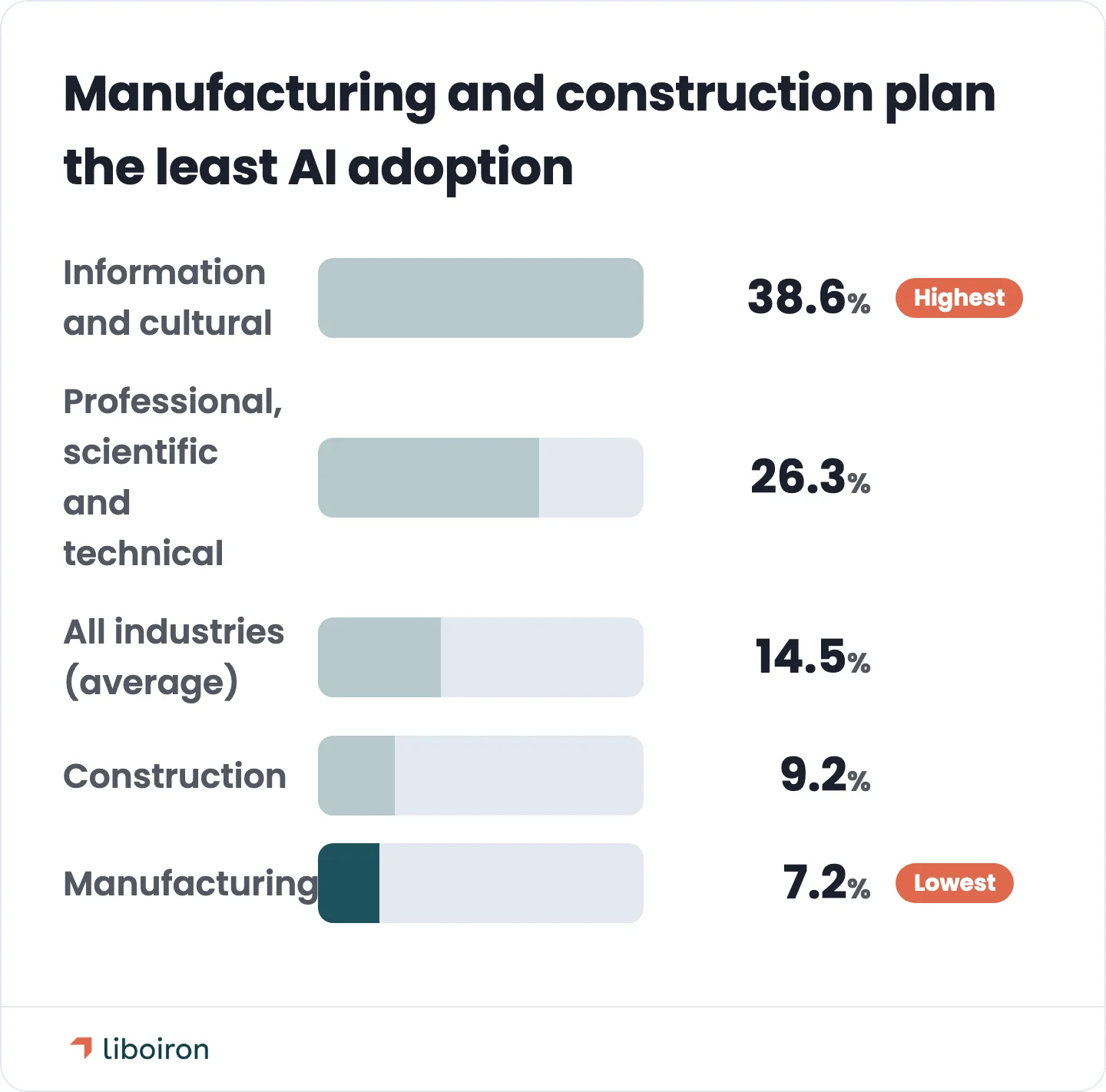
Planned AI adoption among Canadian businesses, by industry:
For Canadian manufacturers and construction firms, that lag is both a warning and an opening: the sectors slowest to adopt AI are also the ones with the most manual, repeatable work left to automate.
AI Adoption by Company Size, Role, and Region
Within Canada, AI use tracks closely with occupation, firm size, and province. The divide between science and management roles and everyone else is stark.
- Generative AI use is highest in natural and applied sciences occupations, at about 49%. Technical roles adopt AI first, per Statistics Canada worker data.
- Management occupations follow at about 38%. Decision-makers are among the heaviest AI users, Statistics Canada found.
- AI adoption rises with company size. Larger Canadian firms are consistently more likely to use AI than small businesses, per Statistics Canada.
- Over the past year, generative AI use among workers was highest in British Columbia, at 25%, above the 22% national average for the same period. B.C. led the provinces, per Statistics Canada. This past-year average sits below the 30% recorded at the July 2025 endpoint.
- Quebec workers report about 21% generative AI use. Adoption in Quebec sits near the national middle, Statistics Canada found.
- Atlantic Canada trails at about 18%. The regional spread across provinces is roughly 7 points, per Statistics Canada.
Generative AI use by Canadian workers, by region (share who used it over the past year):
AI and Workplace Productivity
AI does raise productivity, but the measured, adjusted gains are more modest than vendor headlines suggest. The honest number is single digits, not multiples.
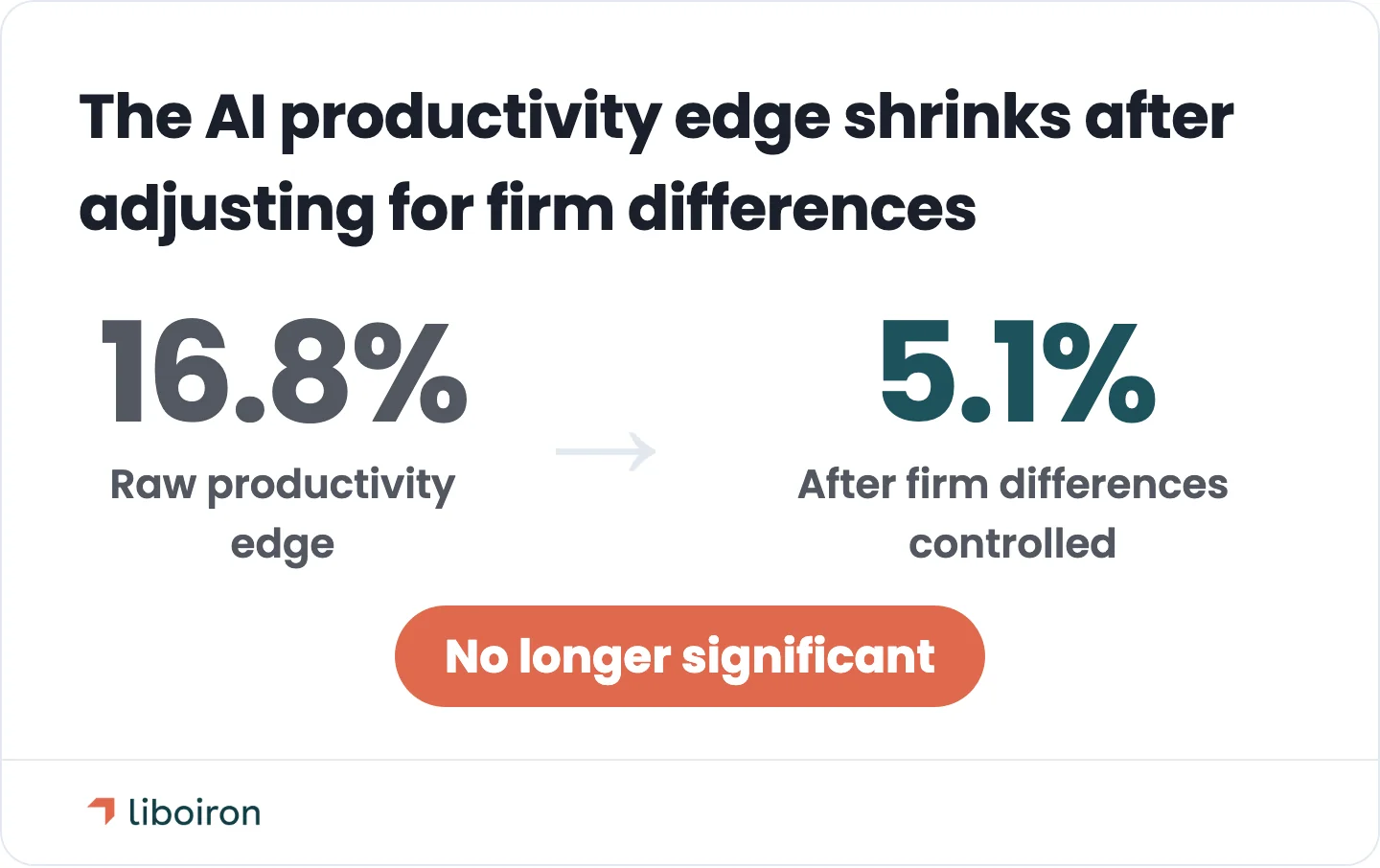
- AI adopters show a 16.8% higher productivity level than non-adopters before adjustment. The raw gap looks large, per Statistics Canada.
- That premium falls to 5.1% and becomes statistically insignificant once firm differences are controlled for. Much of the raw gain reflects which firms adopt AI, not the AI itself, Statistics Canada found.
- Employees can save up to one full workday per month by using AI. Time savings are real but incremental, according to Microsoft's Work Trend Index.
- Industries most exposed to AI saw revenue per employee grow 27%, three times the 9% growth in the least-exposed industries. PwC links AI to a nearly fourfold rise in productivity growth overall, concentrated where the work is most exposed to it.
- AI's time savings often turn into more output rather than shorter days. Fortune calls this the AI productivity paradox, describing one worker who cut an eight-hour task to two hours and was then expected to take on far more work.
- Even in remote-capable roles, only 19% of US employees use AI every day. Daily, embedded use is still the minority even among the heaviest adopters, per Gallup.
AI's Impact on Jobs and Skills
Most Canadian workplaces report no job cuts from AI so far, but exposure is broad and the training gap is real. The story is transformation, not mass layoffs, at least for now.
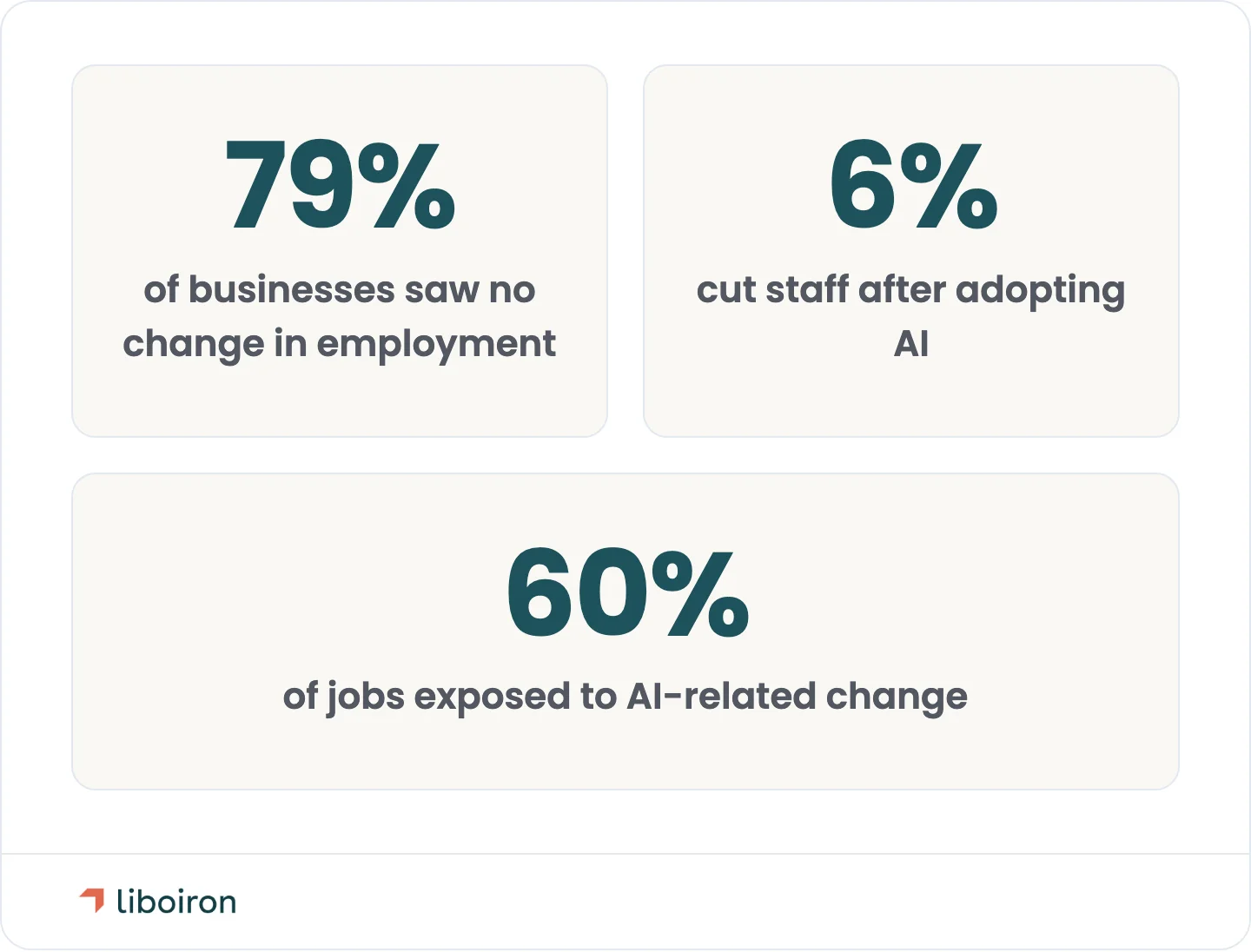
- 79% of Canadian businesses reported no change in employment levels after adopting AI. Job losses have been the exception, not the rule, according to the Environics Institute and Toronto Metropolitan University.
- Only about 6% of AI-using Canadian businesses reduced their staff. Direct AI-driven cuts remain rare, per Statistics Canada.
- About 60% of Canadian employees are in jobs exposed to AI-related transformation. Exposure does not mean replacement, but it does mean the work will change, per Statistics Canada.
- Roughly 4.2 million Canadian workers (31%) are in high-exposure, low-complementarity jobs. These are the roles where AI is most likely to substitute for tasks rather than assist them, Statistics Canada found.
- Workers with AI skills command a 56% wage premium, up from 25% the year before. The pay gap for AI-capable workers more than doubled in a year, per PwC.
- 78% of leaders are considering AI-specific hires in the next 12 to 18 months. Demand is shifting toward AI skills, according to Microsoft's 2025 Work Trend Index.
- Nearly half of AI-using Canadian workers received no formal training on the tools. Most people are self-teaching, per the Environics Institute.
- Job availability grew 38% in the roles most exposed to AI. Hiring is still rising even where AI is most active, though more slowly than in less-exposed roles, per PwC.
How Workers Feel About AI
Optimism and anxiety about AI now sit side by side, and the anxiety is climbing. Employers who ignore the sentiment gap risk quiet resistance.
- 42% of Canadian workers fear their roles will soon be replaced by computers or robots, up from 27%. Replacement anxiety has risen sharply in a short time, per the Environics Institute.
- 47% of workers say their workplace has been too slow to adopt new technology. Nearly as many worry their employer is behind as worry about being replaced, Environics found.
- 45% of CEOs say most employees are resistant or even hostile to AI. Leadership sees real friction on the ground, according to Kyndryl's 2025 People Readiness Report.
- 52% of people using AI at work are reluctant to admit they use it. Even active users often keep it quiet, per Microsoft's Work Trend Index.
- Both workers and employers are generally very positive about AI's impact on job performance. Despite the anxiety, direct experience with AI skews positive, according to the OECD.
Shadow AI and Unapproved Tool Use
A large share of workplace AI happens outside official policy, on tools employers never sanctioned. This "shadow AI" is now the default, not the edge case.
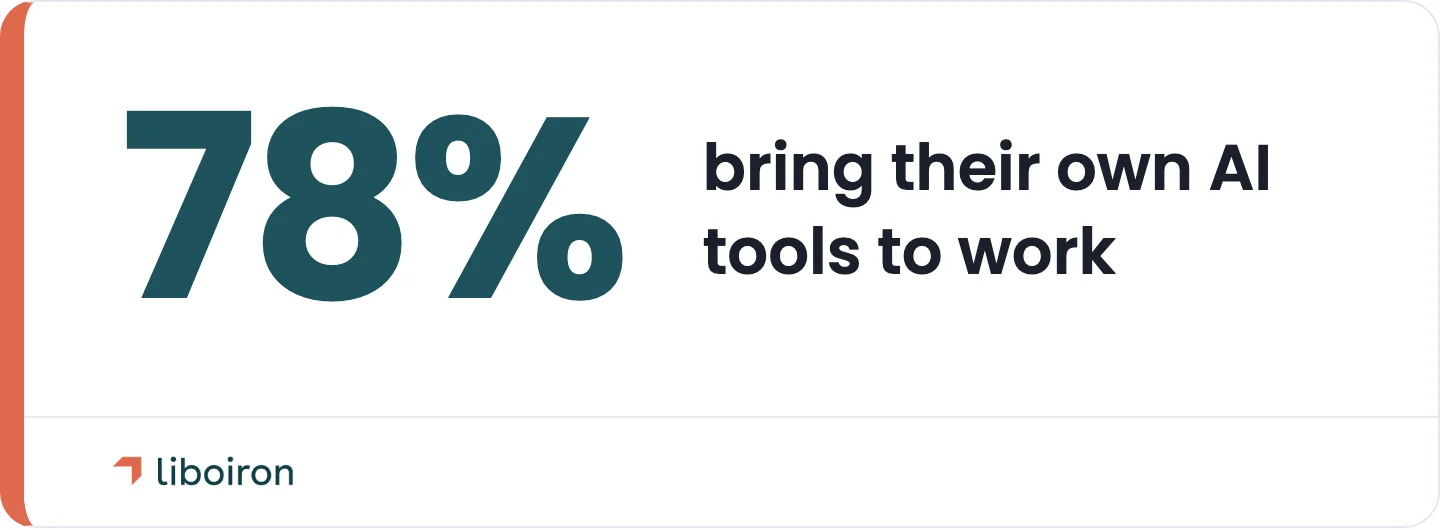
- 78% of AI users bring their own AI tools to work. Most workplace AI runs on personal, unmanaged accounts, per Microsoft's Work Trend Index.
- 66% of office professionals have used AI tools they believed weren't authorized. Two-thirds of workers have knowingly stepped outside policy, according to PagerDuty.
- Nearly half of employees admit to using AI in ways that contravene company policy. Policy and practice are far apart, per Melbourne Business School.
Why Some Businesses Haven't Adopted AI
Among the Canadian businesses that have not adopted AI, the barriers are more about perceived relevance than cost or fear.
- 78.1% of non-adopting Canadian businesses say AI is "not relevant" to their operations. The biggest barrier is perceived irrelevance, not cost or fear, per Statistics Canada.
- 11.3% of non-adopters cite a lack of knowledge and skills as the main barrier. Skills gaps are the second-largest blocker, Statistics Canada found.
- 8.1% of non-adopters point to privacy and security concerns. Data risk is a smaller barrier than most assume, per Statistics Canada.
What Comes Next: Agentic AI
The next phase of workplace AI is agentic: systems that complete multi-step tasks on their own rather than only answering prompts. Adoption here is still early.
- 23% of organizations are already scaling an agentic AI system. Roughly one in four has moved AI agents past testing and into wider use, per McKinsey.
- 39% of organizations are experimenting with AI agents. Most agentic AI still sits in the pilot stage, McKinsey found, which is where much of the next wave of workplace adoption will be measured.
Also read: AI Agent Statistics
Frequently Asked Questions
How many employees use AI in the workplace?
About 30% of Canadian employees used generative AI at work as of July 2025, up from 17% the year before, per Statistics Canada. Globally the figure is higher: 75% of knowledge workers report using AI at work, according to Microsoft. The gap reflects the difference between all workers and knowledge workers specifically.
Is AI adoption higher in Canada or globally?
Canadian worker adoption (about 30%) trails the global knowledge-worker figure (75%), largely because global surveys focus on office and knowledge roles. At the business level, 19.2% of Canadian firms used AI as of the second quarter of 2026, while 88% of organizations worldwide use it in at least one function, per McKinsey. Canadian business adoption is doubling year over year but starting from a low base.
Does AI actually improve workplace productivity?
Yes, but the measured gains are modest. Statistics Canada found AI adopters had a raw 16.8% productivity advantage that fell to about 5% and became statistically insignificant after adjusting for firm differences. Vendor estimates like "one workday saved per month" (Microsoft) are real for heavy users, but the economy-wide, adjusted effect is smaller than headlines suggest.
Is AI taking jobs in Canada?
Not on a large scale yet. 79% of Canadian businesses reported no change in employment after adopting AI, and only about 6% cut staff, per Statistics Canada and the Environics Institute. Still, roughly 60% of Canadian jobs are exposed to AI-related transformation, so the tasks inside many roles are likely to change even where the job itself stays.
What industries are slowest to adopt AI?
In Canada, manufacturing (7.2% planned adoption) and construction (9.2%) have the lowest planned AI adoption of any industries, well behind information and cultural industries at 38.6%, per Statistics Canada. These are also the sectors with the most manual, repeatable work still done by hand.
The Bottom Line
The data points in one clear direction: AI use among Canadian workers is climbing fast, business adoption is doubling but still low, and the gap is widest in the industries built on physical, manual work. Most workplaces report no job losses yet, the productivity gains are real but smaller than the marketing, and a majority of AI use is happening on unapproved tools outside any policy.
The businesses furthest behind are in Canada's factories and job sites. Manufacturing and construction sit at the very bottom of the adoption table, exactly where the manual, repeatable work that AI handles well is most common. At Liboiron, we're a Montreal-based automation agency built on more than 18 years of industrial automation experience, and we help Canadian manufacturers and construction firms turn AI in the workplace from a statistic into working automation. If you want to see how that starts, our methodology walks through the process step by step.
Sources
- Statistics Canada: Generative AI use by workers
- Statistics Canada: AI use by Canadian businesses
- Statistics Canada: Expected AI use by businesses
- Statistics Canada: AI adoption and productivity in Canadian firms
- Statistics Canada: Canadian employment trends in the era of generative AI
- Statistics Canada: AI occupational exposure in Canada
- Environics Institute and Toronto Metropolitan University: Artificial Intelligence at Work
- Environics Institute: Rising concerns about the impact of new technologies on employment
- Gallup: Frequent use of AI in the workplace
- Microsoft: Work Trend Index, AI at Work
- Microsoft: 2025 Work Trend Index
- Stanford HAI: AI Index Report
- PwC: Global AI Jobs Barometer
- McKinsey: The State of AI
- Melbourne Business School: Key findings on AI at work
- OECD: The impact of AI on the workplace
- Fortune: The AI productivity paradox
- PagerDuty: Shadow AI workplace survey
- Kyndryl: People Readiness Report 2025