Table of Contents
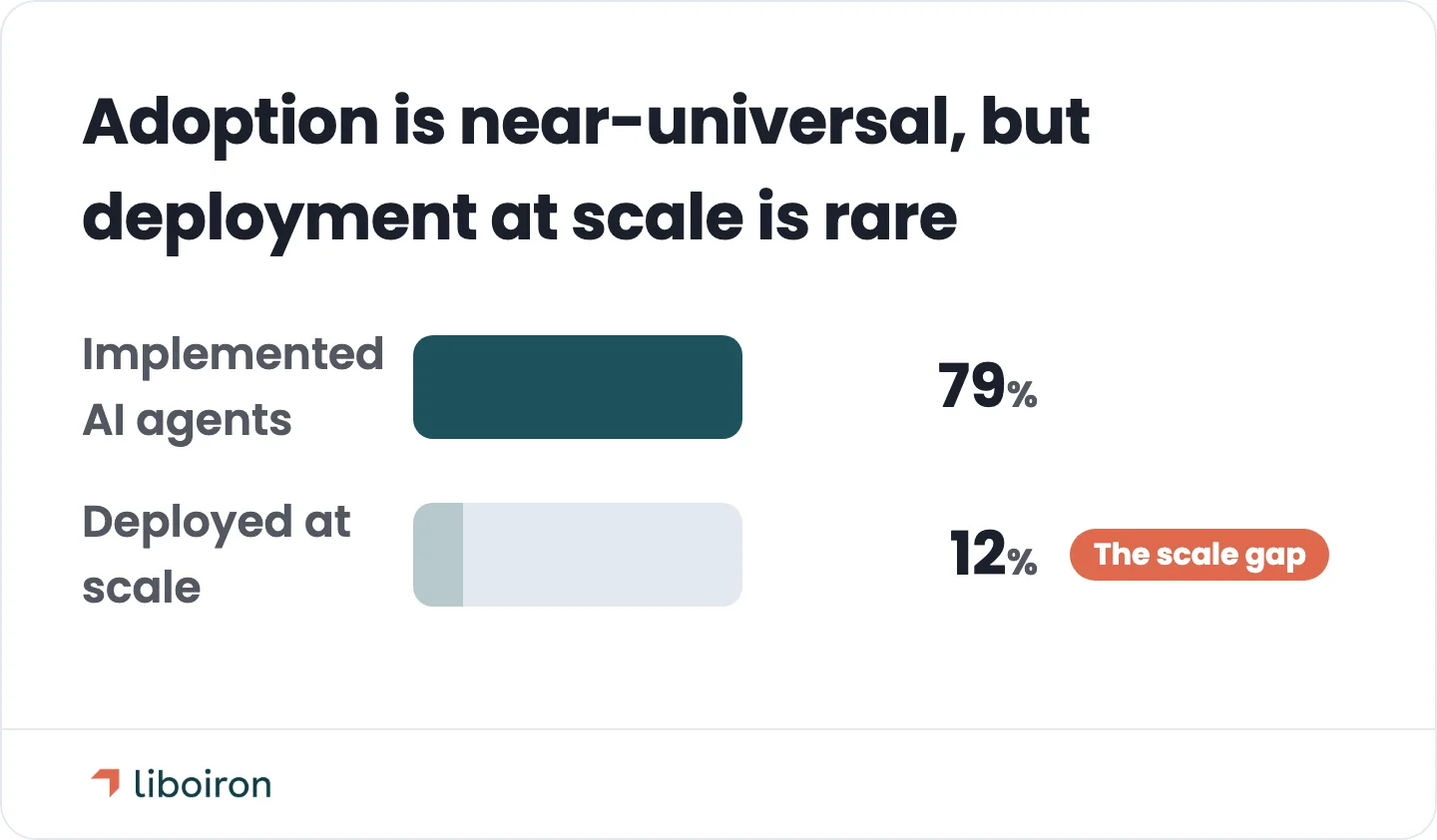
AI agents moved from experiment to budget line in 2026. According to PwC's survey of US executives, 79% of organizations have already implemented AI agents and 88% of senior executives plan to raise their AI budgets. Yet only 12% have deployed agents at scale, and Gartner expects more than 40% of agentic AI projects to be cancelled by the end of 2027.
This is the complete, sourced roundup of AI agent statistics for 2026, with a dedicated section on adoption in Canada that most global roundups skip. Every number is verified against its primary source, and each source is linked once. All data is from 2024 to 2026.
Key Takeaways
- Adoption is near-universal in intent, but rare at scale. 79% of organizations have implemented AI agents, yet only 12% have deployed them at scale.
- The market is compounding between 44% and 50% a year. Estimates put it near US$7.9 billion in 2025, growing toward US$294 billion or more by 2035.
- ROI is real but uneven. Companies expect returns averaging 171%, while Gartner forecasts that 40% of agentic AI projects will be cancelled by 2027 on cost and unclear value.
- Canada sits behind the headline curve. 19.2% of Canadian businesses use any AI (Statistics Canada, second quarter 2026); among CFIB's small-business members, 45% use generative AI.
- The businesses that win start narrow. Customer service (57%) and sales (54%) lead by function, and ready-to-deploy agents outpace custom builds.
AI Agent Market Size and Growth Statistics
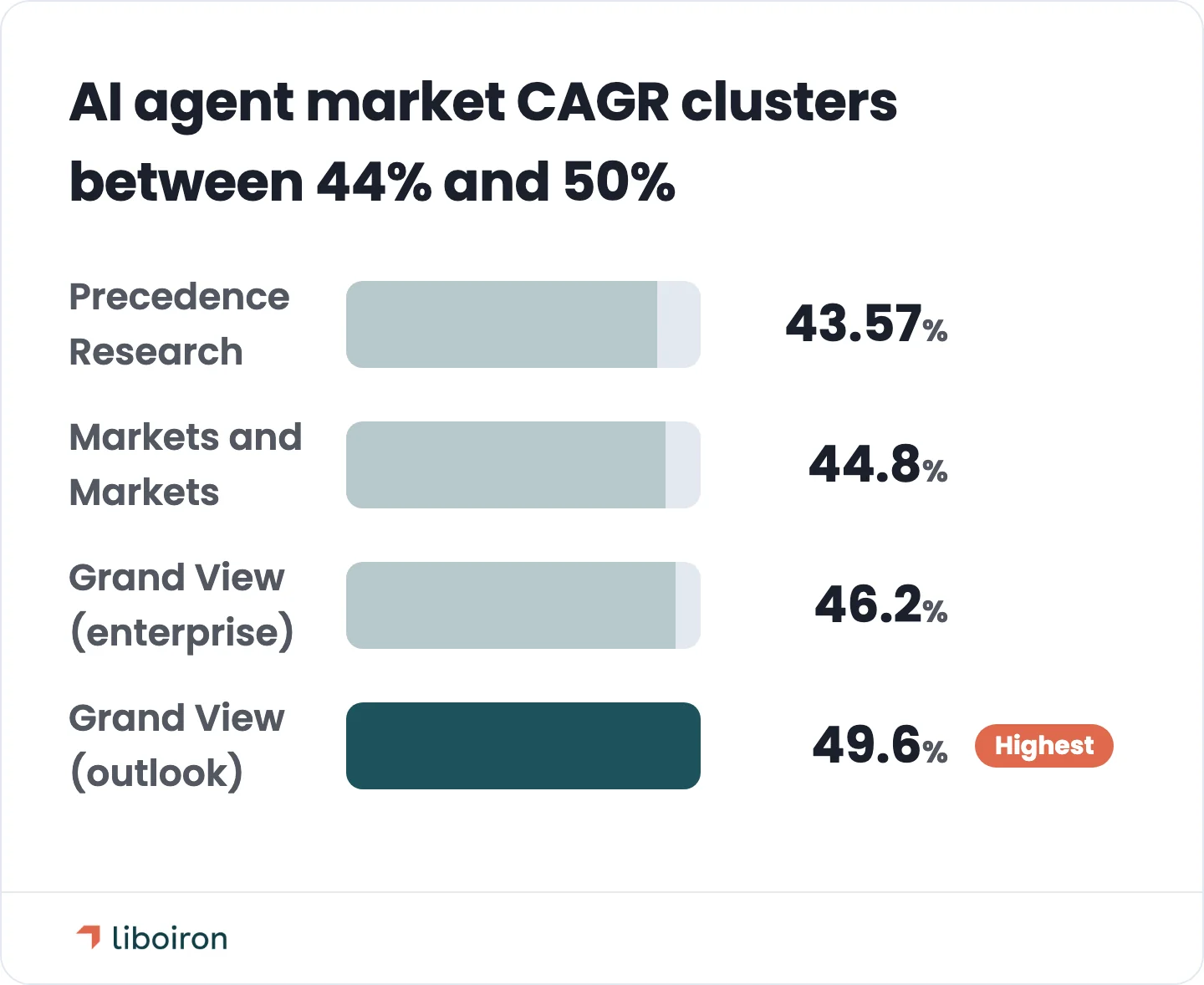
The AI agent market is one of the fastest-growing software categories on record. Research firms disagree on the absolute size, but nearly all put the compound annual growth rate between 44% and 50%. These are the major 2026 market models side by side. Figures are in US dollars, the standard for global market research.
1. The global AI agent market is projected to reach US$294.66 billion by 2035. Precedence Research values the market at US$7.92 billion in 2025 and forecasts a 43.57% compound annual growth rate through 2035.
2. MarketsandMarkets projects the AI agent market will reach US$47.1 billion by 2030. MarketsandMarkets tracks the market rising from US$5.1 billion in 2024 at a 44.8% compound annual growth rate.
3. The enterprise agentic AI segment alone will reach US$24.50 billion by 2030. Grand View Research tracks this segment growing from US$2.58 billion in 2024 at a 46.2% CAGR.
4. Grand View Research's broader outlook forecasts US$182.97 billion by 2033. Its AI agents market outlook values the market at US$7.63 billion in 2025, growing at a 49.6% CAGR through 2033.
5. There will be over 2.2 billion active AI agents in companies worldwide by 2030. Statista forecasts the number of active AI agents rising to more than 2.2 billion by 2030.
6. North America holds 41% of the AI agent market. Precedence Research reports North America dominated with the largest market share, around 41% in 2025.
7. Generative AI could add US$2.6 to US$4.4 trillion to the global economy each year. McKinsey estimates this annual value across the 63 use cases it analyzed. PwC cites the same range in its agentic AI playbook.
AI Agent Adoption Statistics
Adoption headlines are high, but the gap between "implemented" and "deployed at scale" is the real story. Most organizations are experimenting, and far fewer run agents across day-to-day operations.
8. 79% of organizations have already implemented AI agents. PwC surveyed 308 US senior executives and found that 79% say AI agents are already being adopted in their companies.
9. 88% of executives plan to increase their AI budgets in the next 12 months. PwC attributes the budget growth directly to agentic AI.
10. 66% of AI agent adopters report increased productivity. PwC also found that 57% report cost savings among adopters.
11. Only 12% of companies have deployed AI agents at scale. KPMG, surveying US business leaders, found 51% of organizations are exploring AI agents and another 37% are piloting them, while just 12% have deployed them.
12. 51% of organizations already run AI agents in production. LangChain, surveying more than 1,300 professionals, found 51% use agents in production today and 78% have active plans to deploy soon.
13. 90% of non-tech companies use or plan to use AI agents. LangChain found non-tech adoption nearly matches the tech sector.
14. 99% of developers building enterprise AI apps are exploring or developing AI agents. IBM surveyed 1,000 developers and found near-total engagement with agent development.
15. By 2028, 33% of enterprise software applications will include agentic AI. Gartner forecasts this jump from less than 1% of applications in 2024.
16. At least 15% of day-to-day work decisions will be made autonomously by 2028. Gartner projects this rise from 0% in 2024.
17. 40% of Fortune 500 companies use CrewAI's AI agents. eMarketer reported this level of framework adoption among the largest US companies, mostly in pilot projects.
18. 84% of technology leaders expect to hire in the next six months because of AI. EY found agentic AI is coinciding with hiring at tech firms rather than layoffs.
Agentic AI Architecture Statistics
Most companies buy ready-made agents rather than build them from scratch. The market is also shifting from single agents toward coordinated multi-agent systems.
19. Ready-to-deploy agents make up 58.5% of implementations. Market.us found production-ready solutions outpace custom development in the agentic AI market.
20. Multi-agent systems account for 66.4% of the market. Market.us reports most deployments coordinate several specialized agents rather than relying on one.
21. AI-enabled workflows will grow from 3% of operations in 2024 to 25% by 2026. IBM's Institute for Business Value calls this an eightfold increase in two years.
AI Agent ROI and Productivity Statistics
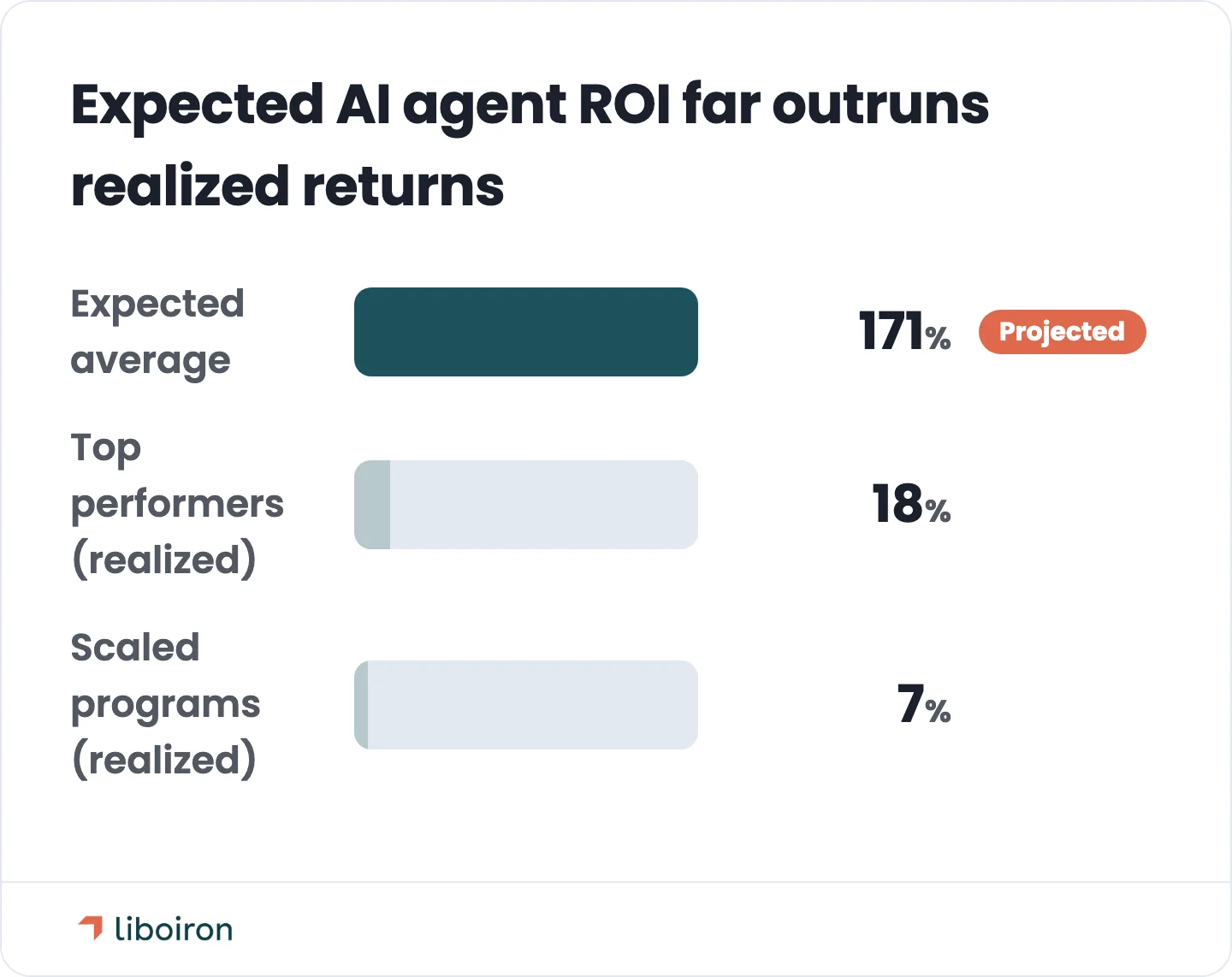
Expected returns are high, but the headline ROI numbers are projections. Realized returns for scaled programs run lower. The gap between the two is why scoping matters.
These named enterprise AI deployments show the clearest results, drawn from PwC's agentic AI executive playbook and the underlying research.
22. Companies expect agentic AI to return 171% on average. PagerDuty surveyed executives across the US, UK, Australia, and Japan; the US respondents expect an even higher 192%. These are expected returns, not realized ones.
23. 62% of companies expect returns above 100% from agentic AI. This projection also comes from PagerDuty's research.
24. Scaled AI programs deliver a more modest 7% return today. IBM found top-performing organizations achieve about 18% ROI, well below the projected averages.
25. Companies see 20% to 60% productivity gains across applications. McKinsey documented this range, including a 30% improvement in credit turnaround at one lender.
26. AI agents can cut content production costs 95% and speed up output up to 50 times. BCG found one workflow moved blog publishing from four weeks to a single day.
27. One bank cut customer-interaction costs roughly tenfold with AI virtual agents. BCG cites this as an example of how much cost routine-task agents can remove.
AI Agents in Customer Service and Sales
Customer service and sales lead adoption by function, and consumers are readier for AI agents than many businesses assume.
28. Customer service is the top function for AI agents at 57% adoption. PwC's US survey found sales and marketing follow at 54%, and IT or cybersecurity at 53%.
29. The technology sector accounts for 46% of AI agent demand. Lyzr found consulting and professional services follow at 18%, and financial services at 11%.
30. 83% of sales teams using AI saw revenue growth, versus 66% of teams without it. Salesforce found AI-using sales teams were far more likely to grow revenue over the past year.
31. 68% of customer service interactions will be handled by agentic AI by 2028. Cisco forecasts this shift within three years for technology vendor support.
32. 44% of US consumers would use an AI agent as a personal assistant. Salesforce found interest rises to 70% among Gen Z.
AI Agent Barriers, Failures, and Security Statistics
The most important AI agent statistic of 2026 may be a warning. Failure rates are high, security gaps are common, and most "agentic" vendors are not what they claim.
33. More than 40% of agentic AI projects will be cancelled by the end of 2027. Gartner attributes the cancellations to escalating costs, unclear business value, and inadequate risk controls.
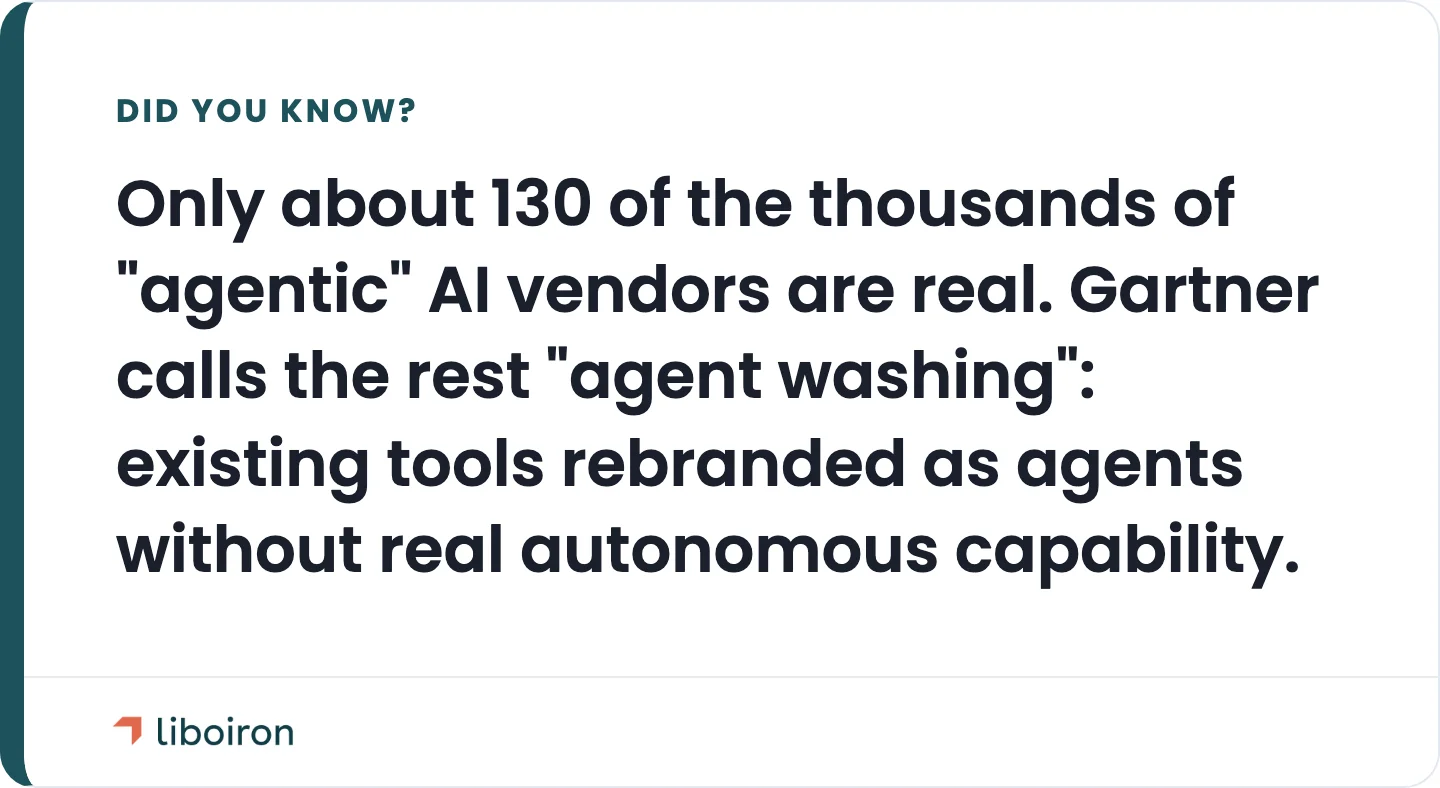
34. Only about 130 of the thousands of agentic AI vendors are real. Gartner calls the rest "agent washing," where existing tools are rebranded as agents without real autonomous capability.
35. 80% of companies report their AI agents taking unintended actions. In SailPoint's survey, where 82% of organizations already use AI agents, 33% also report agents accessing or sharing sensitive data.
36. 92% of organizations say governing AI agents is critical, but only 44% have policies in place. SailPoint's research exposes the gap between concern and control.
37. Unreliable performance is the single biggest obstacle to AI agent adoption. LangChain found performance quality concerns more than twice as significant as any other barrier, including cost and safety.
38. IT security is the top enterprise concern about agentic AI at 56%. UiPath found cost of implementation (37%) and integration with existing systems (35%) follow.
39. 62% of businesses lack a clear starting point for AI agents. Lyzr found 32% of pilots stall and never reach production.
AI Agent Adoption in Canada
Canadian AI adoption trails the global headline numbers, and few international roundups cover it. Here is the primary Canadian data from Statistics Canada and the Canadian Federation of Independent Business (CFIB). These two sources measure different populations and different things: Statistics Canada surveys a broad official sample and tracks any AI use, while CFIB surveys its small-business member panel and tracks generative AI specifically. That is why CFIB's generative-AI figure runs higher than Statistics Canada's any-AI figure.
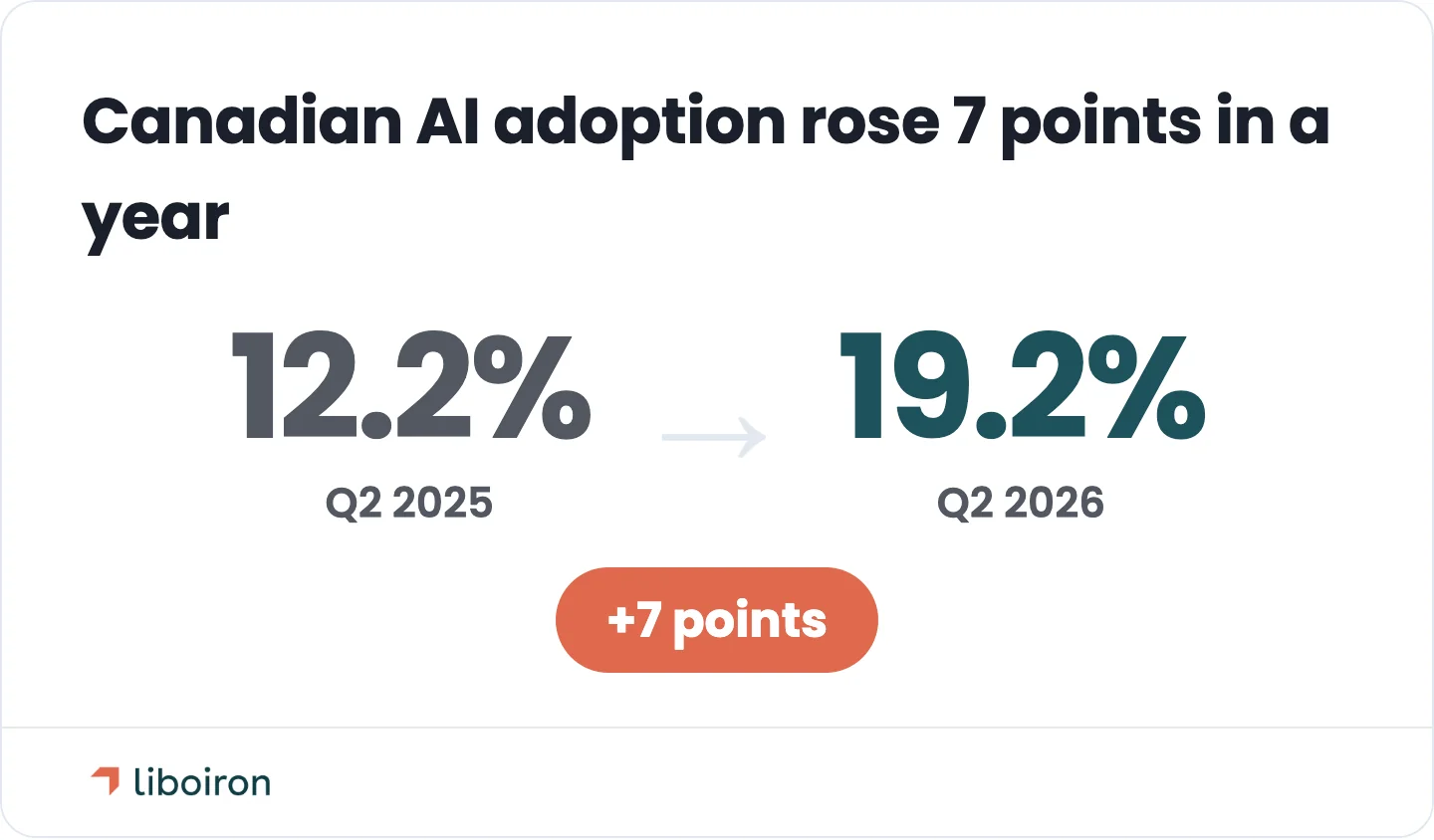
40. 19.2% of Canadian businesses used AI in the past 12 months. Statistics Canada reports this is up from 12.2% in the second quarter of 2025.
41. Information and cultural industries lead Canadian AI adoption at 42.3%. Statistics Canada found finance and insurance (40.4%) and professional, scientific, and technical services (32.4%) close behind.
42. Construction is among the lowest-adopting Canadian industries at 9.2%. Statistics Canada found agriculture (4.5%) and wholesale trade (7.9%) also lag the national average.
43. Data analytics is the top AI application for Canadian businesses at 36.6%. Statistics Canada found text analytics (34.5%) and virtual agents or chatbots (28.2%) follow.
44. 45% of CFIB-surveyed businesses use generative AI in their operations. CFIB found adoption rises sharply with firm size, reaching 60% and above at businesses with 20 to 49 employees.
45. 47% of Canadian businesses say they are investing in AI. CFIB tracked this investment intent across firms of all sizes.
46. Canadian small and mid-sized firms gain 2.05 hours a day from AI tools. CFIB found these businesses gain more than twice the time they invest, against 0.97 hours spent.
47. Nearly 70% of Canadian businesses expect no employment impact from AI over the next 12 months. CFIB found most firms see AI as a productivity tool rather than a headcount cut.
What the Data Means for Canadian SMBs
The numbers tell one clear story: intent is nearly universal, but execution is where most companies stall. The gap between 88% raising budgets and 12% deploying at scale is not a technology problem. It is a scoping problem.
The businesses that see a real return are the ones that start with a single agent on a defined workflow, keep a human in the loop, and buy a ready-to-deploy agent before commissioning a custom build. That is the opposite of the company-wide autonomous rollout that shows up in Gartner's cancellation data.
We are a Montreal-based automation agency, and this is the work we do for Canadian manufacturers and construction firms. Our pre-built agents for invoice matching, order processing, and payroll approval each target one defined task, so a first project proves out quickly instead of stalling. We tie our fee to the result, not the hours. If you want to map where an agent fits in your operations, our free strategic call is the place to start.
Also read: AI in the Workplace Statistics
Frequently Asked Questions
How many companies use AI agents in 2026?
79% of organizations have implemented AI agents in some form, according to PwC. Deployment lags adoption: only 12% have deployed agents at scale, according to KPMG, even as a majority of AI-focused teams report running agents in production.
How big is the AI agent market?
The global AI agent market is valued around US$7.9 billion in 2025 (Precedence Research), with 2024 estimates near US$5.1 billion (MarketsandMarkets). Forecasts range from US$47.1 billion by 2030 to US$294.66 billion by 2035. Nearly all models put the compound annual growth rate between 44% and 50%.
What ROI do AI agents deliver?
Companies expect an average return of 171%, according to PagerDuty. Realized returns run lower for scaled programs, closer to 7% on average and about 18% for top performers, according to IBM. The gap reflects how many projects stall before reaching production.
Why do AI agent projects fail?
Gartner forecasts that more than 40% of agentic AI projects will be cancelled by the end of 2027, citing escalating costs, unclear business value, and inadequate risk controls. Unreliable performance is the most-cited obstacle, according to LangChain.
How many Canadian businesses use AI?
19.2% of Canadian businesses used AI in the past 12 months, up from 12.2% a year earlier, according to Statistics Canada. Measuring generative AI specifically, CFIB found 45% of the businesses it surveyed use it, rising to 60% and above at firms with 20 to 49 employees.
Which industries use AI agents the most?
The technology sector accounts for 46% of AI agent demand, followed by consulting at 18% and financial services at 11%, according to Lyzr. By function, customer service leads at 57% adoption, ahead of sales and marketing at 54%.
The Bottom Line
The 2026 data settles one question and raises another. Adoption is no longer in doubt: four in five organizations have implemented AI agents, budgets are climbing, and the market is compounding between 44% and 50% a year. What is still in doubt is execution. Only 12% of companies have deployed agents at scale, expected returns outrun realized ones, and Gartner expects 40% of projects to be cancelled by 2027.
For an operator, the statistic that matters is not the market size. It is the cancellation rate, and the scoping discipline that avoids it. The winners treat a first agent as a scoped bet on one workflow, not a company-wide leap.
For Canadian businesses deciding where AI agents actually fit, the answer starts small. At Liboiron, we build and deploy AI agents for Canadian SMBs one workflow at a time, with pricing tied to the result. If you are weighing a first agent, see how we approach it.
Sources
- Precedence Research: AI Agents Market
- MarketsandMarkets: AI Agents Market
- Grand View Research: Enterprise Agentic AI Market
- Grand View Research: AI Agents Market Outlook
- Statista: AI Agents Worldwide
- PwC: Agentic AI Executive Playbook
- PwC: AI Agent Survey
- KPMG: AI Quarterly Pulse Survey
- LangChain: State of AI Agents
- IBM: AI Agents Expectations vs Reality
- Gartner: Over 40% of Agentic AI Projects Will Be Cancelled by 2027
- eMarketer: 40% of Fortune 500 Companies Using CrewAI's AI Agents
- EY: Technology Companies and Agentic AI
- Market.us: Agentic AI Market
- IBM Institute for Business Value: Agentic AI and Profits
- PagerDuty: Companies Expecting Agentic AI ROI
- McKinsey: Seizing the Agentic AI Advantage
- BCG: AI Agents
- Lyzr: State of AI Agents
- Salesforce: AI Agents Statistics
- Cisco: Agentic AI to Handle 68% of Customer Service by 2028
- Salesforce: Consumers Ready for AI Agents
- SailPoint: AI Agent Adoption Report
- UiPath: Agentic AI Report Findings
- Statistics Canada: Businesses Using AI
- CFIB: AI Adoption
- McKinsey: The Economic Potential of Generative AI